Anti-aging
Ablative Skin Reconstruction
Ablative skin resurfacing removes damaged skin in controlled micro-columns, so healthy tissue rebuilds in its place. Older catalogues call it ablative skin reconstruction. Two wavelengths do the work: CO2 at 10600nm and Er:YAG at 2940nm. Results are the strongest in laser rejuvenation. Downtime is real. You plan around it.
What ablative skin resurfacing actually is
Photoaged skin loses its collagen scaffold. It thins, slackens, roughens, and the pores widen. Non-ablative devices heat the dermis and leave the epidermis whole, which is comfortable but slow. Ablative devices go the other way: vaporise the epidermis and a slice of upper dermis, then let wound healing rebuild the gap. Our engineering archive adds a detail people overlook: dermal collagen contracts near 65 degrees Celsius, so residual heat around each column tightens skin as the ablation removes it.
Full-field ablation treats every square millimetre. Fractional ablation drills a grid of microscopic columns, leaving intact skin between them and cutting healing time sharply. Almost every clinic buying today buys fractional. Our breakdown of ablative versus non-ablative fractional laser goes deeper.
How CO2 and Er:YAG lasers do the work
Both wavelengths chase one chromophore: water. Water absorbs weakly across the visible range and stays weak through 1000nm to 1100nm, which is why a 1064nm Nd:YAG beam travels deep instead of vaporising the surface. Push into the infrared and absorption climbs. The strongest peak for dermatology is 2940nm. Hale and Querry's 1973 measurements of the optical constants of water remain the reference behind those curves. Our internal training material makes the same qualitative point: 2940nm sits on the strongest water peak, and 10600nm is absorbed less strongly.
One fact, two very different machines. Er:YAG sits on the peak. It cuts cleanly and ablates shallowly, leaving a thin rim of residual heat, so healing runs faster and pigment complications tend to be less frequent. CO2 turns more energy into heat around each column. More coagulation. More tightening. More redness.
Neither wins outright. Deep boxcar scars reward CO2; thin, delicate skin does better on erbium. Anderson and Parrish's 1983 paper on selective photothermolysis still frames the call: match the wavelength to the target, control the pulse, spare the neighbours.
Indications, contraindications and skin type
Ablative work earns its downtime on structure, not surface dullness. Typical indications: atrophic acne scars, surgical and traumatic scars, wrinkles visible at rest, actinic cheilitis, coarse photoaged texture, and growths such as syringoma.
The exclusion list matters more. Our device manuals list isotretinoin within the past one to two years, keloid tendency, scleroderma, immunosuppressant therapy, previous radiotherapy to the area, active herpes simplex, psoriasis, severe eczema, vitiligo, poorly controlled diabetes, significant cardiovascular disease, and pregnancy. Any lesion that might be malignant needs a diagnosis, often a biopsy, before a laser goes near it. Refer first.
Darker Fitzpatrick phototypes carry a higher risk of post-inflammatory hyperpigmentation after any ablative procedure. It's usually temporary, and it settles faster with strict sun avoidance. Say so at consultation, not afterwards.
Treatment protocol, safety and what to expect
This is a planned procedure, not a lunchtime facial. Topical anaesthetic under occlusion for 30 to 60 minutes is standard. Test the beam on photographic paper, then trial a pass somewhere inconspicuous.
Passes are where operators get into trouble. Our manuals cap treatment at three per site and give three stop signs: the scar or wrinkle has gone, the tissue turns yellow-brown, or further passes add no tightening. Spot patterns must not overlap. Overlapping shots stack heat, deepen the wound, and that's how scars happen.
Before the first pass
- Antiviral prophylaxis is standard before facial ablative resurfacing, whether or not the patient reports a herpes simplex history. De-epithelialised skin gives the virus an open field, and disseminated reactivation can scar. Cover usually runs through re-epithelialisation, with agent and duration left to the treating clinician.
- Antibacterial or antifungal cover, case by case under local protocol, decided by the prescriber.
- Wavelength-rated eyewear for everyone in the room, and for the patient whenever the treated skin sits away from the eyes. 10600nm and 2940nm each need their own rating, and the 635nm aiming beam is a separate hazard. Never look into either beam.
- Periorbital or eyelid treatment needs internally placed, laser-rated metal corneal eye shields. External goggles cover the very skin you're about to ablate, so once the beam works inside the orbital rim they protect nothing. The treating clinician inserts the lubricated shields before the first pass and removes them after the last. No shield, no periorbital pass.
- Matte instruments, a clear beam path, controlled access and signage. Our guide to laser safety essentials for clinics covers room setup.
- Plume evacuation running throughout, so the field stays clear and nobody inhales smoke.
- Fire precautions. Alcohol preps, dry gauze and supplemental oxygen don't belong near an active beam, and our manuals bar flammable solvent on the site or the pattern generator.
| Variable | What to plan for |
|---|---|
| Sessions | Often one substantial fractional session, sometimes a series |
| Passes per area | Three maximum; periorbital skin one to two, corneal shields in place |
| Swelling | Peaks day two to three, settles by day five to seven |
| Social downtime | About a week fractional, longer full-field; redness runs for weeks |
| Follow-up | Day 1, day 3, weeks 1, 3 and 6, month 3 |
Results build over months. Collagen keeps organising long after the surface heals, so judge at the three-month review. Treat the whole cosmetic unit, never an isolated patch. Outcomes vary with lesion depth, skin type and aftercare.
Recommended Pmise equipment, and what to check before buying
Our ablative workhorse is the Ultrapulse CO2 Fractional Laser (10600nm) range, built on an RF-excited metal tube rather than glass, which gives a steadier beam and longer service life. CF-01, CF-02 and CF-03 carry three output modes: continuous wave for cutting and lesion removal, UltraPulse for pigmented and raised lesions, fractional for resurfacing. CF-05 is the budget option.
Published specification: focal spot 50 to 2000 microns, pulse energy 2mJ to 200mJ in 2mJ steps, densities of 6x6, 12x12 and 24x24 dots per square centimetre, giving ablation ratios near 1.56%, 6.25% and 25%. A 635nm aiming beam runs coaxially, because 10600nm is invisible. For shallower work, the CF-08 Er:YAG 2940nm pixel laser runs 75 to 100 micron focal spots. Want both depths in one chassis? The Dual Mode Fractional Laser, model DF-01, pairs a 1550nm non-ablative source with a CO2 fractional one.
Get these in writing before shortlisting:
- Certification. Our records hold EC declarations of conformity against the applicable European medical device rules and the EN 60601 safety and EMC series, plus ISO 9001 and ISO 13485 certification. Which certificate covers which model, and what your country adds, is confirmed per market.
- Warranty. One year of free warranty service from date of purchase, with maintenance available for the life of the machine. Wear items such as the scanner, foot switch and articulated arm sit outside the free-parts scope.
- Training and installation. Technical instructors deliver operator training after purchase, backed by remote support. Get the scope into the contract.
- Consumables and servicing. An RF metal tube outlasts glass, but arm alignment, scanner and optics need scheduling. See our guide to warranty and spare parts.
- Lead time and after-sales coverage. Both vary with model, configuration, voltage standard and territory, so both are quoted per order.
Ready to compare? Ask for the spec sheet and quotation through our contact page, naming your market or territory, and we'll confirm certification, warranty and lead time.
Aftercare and precautions
- Ice and elevate for 48 hours. Swelling is expected, not a complication.
- Pick one wound-care strategy and stick to it. Open care means dilute acetic acid soaks and continuous ointment. Closed care means an occlusive dressing applied within two hours and changed daily, which heals faster.
- Keep the skin moist. Epidermal maturation needs a damp environment, and dry crusts pull. No exfoliation, acids or salon facials until the barrier is intact.
- Watch for infection from day two. New or escalating pain, burning, patchy erythema, yellow exudate or pustules warrant prompt clinical review. Antimicrobial decisions belong to the treating clinician.
- Itching in week two is usually normal re-epithelialisation. Persistent, worsening or pustular itching needs clinical assessment, since candidiasis and contact dermatitis both show up in this window. Either way, stop the scratching.
- Sun avoidance isn't optional. Ultraviolet exposure drives matrix metalloproteinase activity, degrading the collagen you just built.
- Warn about delayed hypopigmentation. It can surface six to twelve months later, tracking with heavy overlap and excess passes.
This page is educational material for clinics, distributors and equipment buyers. It isn't medical advice, and it never replaces care by a qualified clinician.
Frequently Asked Questions
How much downtime should a patient really expect?
For fractional work on the face, plan on roughly a week away from public-facing commitments. Swelling peaks around day two or three and settles by day five to seven, then pinkness fades over the following weeks. Full-field ablation runs longer, and aggressive settings push recovery out further. Quote a range.
CO2 or Er:YAG for acne scarring?
Deep atrophic scars generally respond better to CO2, because the extra coagulation contracts the scar floor as well as removing tissue. Er:YAG suits shallower rolling scars and patients who can't take long recoveries. Our comparison of CO2 versus Er:YAG versus 1550nm fractional lasers sets out the trade-offs by indication.
Can ablative resurfacing be used on darker skin?
Yes, with caution and conservative settings. Higher Fitzpatrick phototypes tend more strongly toward post-inflammatory hyperpigmentation, so many practitioners cut density, limit passes, prepare the skin under dermatological guidance and insist on photoprotection. A test patch in a hidden area, reviewed weeks later, is worth the wait.
Recommended Equipment
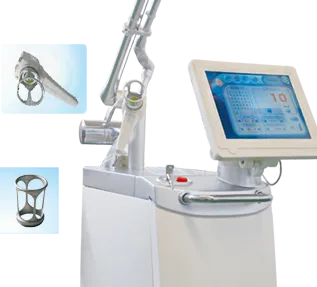
Pmise CF-03
Three output modes: CW, UltraPulse and Fractional.The COHERENT RF-excited metal laser system enables the output quality …
View details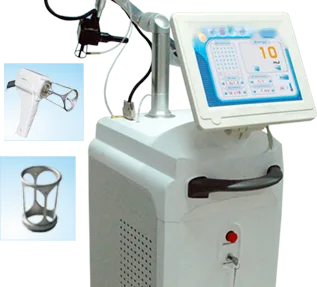
Pmise CF-05
Max. laser power 30W,40W and 50W for optional. Cost-effective with high quality, most competitive for doctors. Most conv…
View details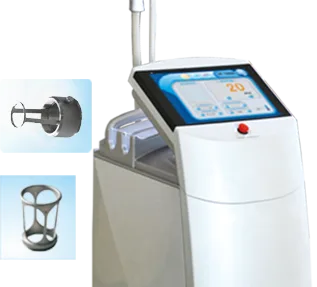
Pmise EF-02
The target tissue is water, no skin type limit (Fitzpatrick I-VI). The output spot diameter is 50-80 um, less thermal ab…
View details