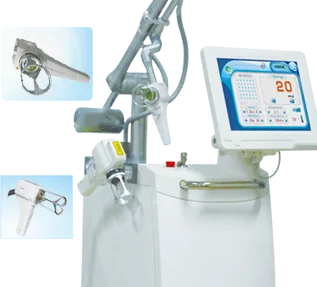
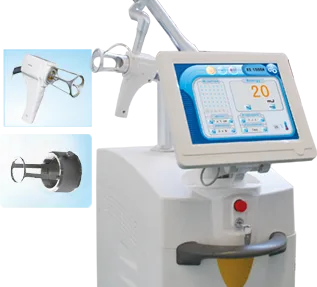
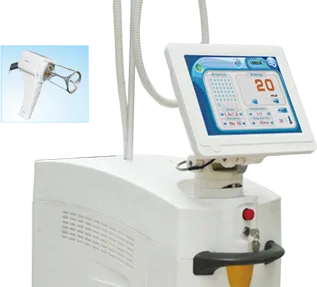
The short version of any fractional laser comparison: CO2 at 10600nm goes deepest and charges the most recovery time, Er:YAG at 2940nm ablates cleanly with less heat left behind, and 1550nm skips ablation so patients can go back to work. The rest is detail. Which one earns space in your treatment room depends on who walks through your door and the downtime they'll accept.
Why the wavelength decides how a fractional laser behaves
Water is the target. How strongly a wavelength is absorbed by water sets ablation depth, heat spread and healing time. Our engineering archive gives the baseline: water absorbs very little between 400nm and 800nm, absorption climbs into the infrared, and the water absorption peak sits at 2940nm. That one line explains Er:YAG. It ranks nothing else, because neither 10600nm nor 1550nm is a water peak, so the order has to come from a direct comparison.
Here is that comparison. Laser dermatology references put Er:YAG's water absorption an order of magnitude above CO2: a review from Shatkin Dental & Facial cites 10 to 15 times greater absorption than 10600nm CO2, and the ScienceDirect Er:YAG overview about 16 times higher. CO2 is strongly absorbed, just far less intensely, and it leaves a wider skirt of coagulation around every micro-column. 1550nm sits well down in the near-infrared, absorbed only moderately, which is why it heats columns into the dermis instead of vaporizing the surface. Strongest to weakest: 2940nm, 10600nm, 1550nm. Everything below follows from that order.
Fractional delivery is the other half. The beam is split into microscopic treatment zones, leaving untreated skin between the columns to drive repair. Manstein and colleagues named this fractional photothermolysis in Lasers in Surgery and Medicine in 2004, building on selective photothermolysis from Anderson and Parrish in Science, 1983: pick a wavelength your target absorbs, keep the pulse short, and damage stays put.
Rule of thumb: the more strongly water absorbs a wavelength, the more energy stays at the surface, so ablation is cleaner and deep heat lower. Depth itself still tracks tissue water content, scan passes and energy density, per our technical archive.
CO2 fractional laser (10600nm): the ablative workhorse
A co2 fractional laser is the most aggressive of the three and still the benchmark for deep resurfacing. At 10600nm the beam vaporizes tissue and leaves residual heat around each micro-column. That heat isn't waste. It contracts and rebuilds collagen, which is why CO2 tackles problems the gentler wavelengths only nibble at.
Practical range matters as much as raw power. Per our device documentation, the Pmise CF-01 family runs continuous, ultra-pulse and fractional modes, with a focal spot adjustable from roughly 80 microns to 2mm, spot densities of 6x6, 12x12 and 24x24 per square centimetre, and articulated arm delivery. Swap the lens and one machine covers light rejuvenation through deep peeling. Our documentation also calls the radio-frequency excited source more stable and longer-lived than a sealed glass tube. Ask about that. The source is the expensive part.
- Atrophic and surgical scars, acne scarring included
- Deeper wrinkles, photoaged and lax skin
- Stretch marks and texture reconstruction
- Benign lesions such as warts and small growths
You pay for it in recovery. Ablative CO2 usually means the longest social downtime of the three, with redness, oozing and crusting, plus a higher risk of post-inflammatory hyperpigmentation in darker skin. Operator training isn't optional. Configurations sit on the UltraPulse CO2 fractional laser (10600nm) page, the clinical workflow in our ablative skin reconstruction solution.
Er:YAG laser (2940nm): clean ablation, less heat left behind
An er:yag laser lives on the water absorption peak, so it takes tissue off precisely and leaves comparatively little thermal damage behind. Energy is spent at the surface, penetration is shallower, and recovery is usually quicker than CO2 for the same removal. The flip side: less of the deep residual heat that gives CO2 its tightening effect. Different tools, not better and worse.
The Er:YAG platform in our device manuals runs at 2940nm, with pulse energy up to 2000mJ and a spot reaching 6mm. The handpiece swaps between a focusing tip and a fractional pixel tip, with six microlens options and a spot adjustor. For a clinic running back-to-back afternoon sessions, that swap is worth a whole treatment room.
- Photoaging and rough, uneven texture
- Epidermal pigmented lesions
- Fine to moderate wrinkles
- Scars and superficial benign skin growths
Downtime lands between the other two and moves with your settings. A light epidermal pass heals faster than anything CO2 will hand you, while 1550nm still recovers quicker than either. Push depth, energy and passes and recovery climbs back toward CO2 territory. Don't promise a patient days off work from a brochure.
Now the limitations, which get glossed over in sales meetings. Minimal coagulation is the price of that clean cut: at deeper settings haemostasis is weaker than with CO2, and the field can weep or bleed at pinpoints, which slows the session and blurs the endpoint. Our technical archive is explicit that pulse width must be chosen with care in ablative skin reconstruction, since a longer pulse buys coagulation at the cost of extra thermal damage. And it's still a wound. In higher-melanin skin, post-inflammatory hyperpigmentation is a real risk, so conservative settings and a test spot come first. Read our guide to post-inflammatory hyperpigmentation and our notes on Fitzpatrick skin types and laser settings alongside this.
1550nm fractional: results without the crusting
The 1550nm fractional laser is the gentlest option because nothing is vaporized. An erbium-doped glass fiber source drives microscopic thermal columns into the dermis while the surface barrier stays largely intact. A published in-vivo comparison (PMC3229937) ran a CO2 system alongside a 1550nm system set to about 980 microns deep. Read it carefully, though: no biopsies were taken, so that's the parameter they set, not a measured result.
Coverage is where the design gets interesting. Our documentation for the Pmise EF-01 family gives a focal spot from 50 microns to 2mm and fractional coverage of roughly 1.56%, 6.25% and 25% of the treated area at 36, 144 and 576 spots per square centimetre. That dial decides whether a session is a light refresher or serious remodeling. Pulse width is adjustable across a millisecond-scale range too, letting a physician work with the tissue's thermal relaxation time.
Downtime stays low because there's no open ablation. Most patients get redness and mild swelling that settle quickly, not days of crusting. You give up speed: non-ablative work needs a course of sessions to approach one aggressive ablative pass.
- Photoaging, fine lines and early wrinkles
- Acne scars and atrophic scarring
- Enlarged pores and mild laxity
- Stretch marks and overall texture
Sparing the epidermis is also why 1550nm gets positioned for a broad range of skin tones. Specifications sit on the Erbium glass fractional laser (1550nm) page, treatment logic in our non-ablative skin resurfacing solution, plus a fuller ablative versus non-ablative breakdown on the blog.
Downtime versus result: the trade-off at a glance
How much recovery buys how much result? Read the rows as settings- and operator-dependent, not guarantees.
| Attribute | CO2 (10600nm) | Er:YAG (2940nm) | 1550nm |
|---|---|---|---|
| Type | Ablative | Ablative | Non-ablative |
| Water absorption | Strong | Strongest, on the peak | Moderate |
| Residual heat, tightening | Highest | Low to moderate | Moderate, contained columns |
| Haemostasis while ablating | Better, wider coagulation | Weaker at depth | Not applicable |
| Best for | Deep scars, deep wrinkles, laxity | Texture, epidermal pigment, fine wrinkles | Fine lines, early aging, maintenance |
| Result per session | Highest | Moderate to high | Gradual, over a course |
| Relative downtime | Longest | Between the other two | Shortest |
Which one should you actually buy?
Wavelength follows your patient base, not the brochure. Four questions usually settle it:
- What do patients ask for by name? Scar and wrinkle correction points at CO2. Texture and pigment refinement points at Er:YAG. Low-commitment maintenance points at 1550nm.
- How much downtime will they tolerate? Office workers who cannot vanish for a week pick 1550nm or Er:YAG, whatever the before-and-after photos say.
- Which skin types do you serve? Higher-melanin populations need conservative settings and careful test spots. Non-ablative protocols are usually easier to manage safely.
- One machine or a menu? Plenty of clinics pair an ablative platform with a non-ablative one. If floor space says no, a dual mode fractional platform such as the Pmise DF-01 puts both sources in one cabinet.
What to verify before you place the order
Clinical fit is only half a purchase. The other half decides whether the device is serviceable in your market, and that matters more than the sticker price.
- Certification: CE marking for European sale, ISO 13485 for the factory, plus whatever your regulator demands. Ask for certificate numbers and scope, not a logo on a PDF. Our FDA 510(k) versus CE guide explains why the two aren't interchangeable.
- MOQ and lead time: can you order a single sample unit, and what's the realistic lead time?
- Warranty and spare parts: term on the source and handpieces, expected source lifetime, consumable tips, and who answers the phone in your time zone.
Next step: request a quote, name your target market so we can confirm the certification package, and ask for a demo.
Frequently Asked Questions
Is CO2 or Er:YAG better for acne scars?
Both work, at different depths. CO2 pairs deeper ablation with collagen-tightening residual heat, which suits established atrophic scars and costs more downtime. Er:YAG ablates more precisely with less heat, a better match for shallower scarring or patients who need to look presentable fast. Many clinics keep both.
Does a 1550nm fractional laser really have no downtime?
It has far less than an ablative device, since the surface is never vaporized, which is why it gets marketed as a lunchtime treatment. Most patients still see redness and mild swelling that resolve quickly. The honest trade is minimal downtime in exchange for a series of sessions to approach what an ablative laser does in fewer passes.
Why does Er:YAG cause less thermal damage than CO2?
Because 2940nm sits on the water absorption peak. Laser dermatology references put its absorption roughly 10 to 16 times above CO2, so energy is consumed at the surface and little travels deeper. CO2 leaves a wider zone of residual heat around each column: useful for tightening, and the reason recovery runs longer.
Can one machine cover all three jobs?
Not with a single wavelength. A dual platform holding a CO2 source and a 1550nm source covers the ablative and non-ablative ends from one cabinet, which suits clinics short on floor space. Er:YAG stays a separate box. If your caseload is mostly texture and epidermal pigment, buy that first and add depth later.
By the Pmise Technical Team. Pmise manufactures laser and light-based aesthetic systems, including CO2, Er:YAG and 1550nm fractional platforms. This guidance draws on our own device documentation and the published sources cited above. Confirm protocols and safety settings with a qualified physician.