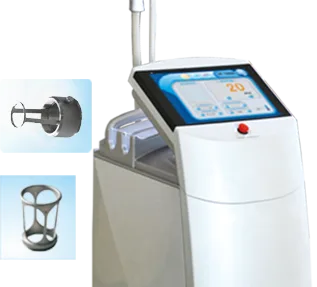
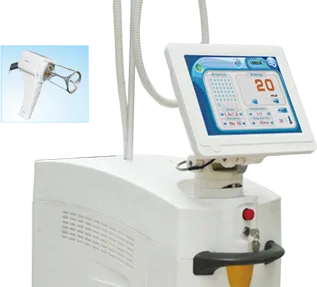
Erbium Glass Fractional Laser (1550nm)
Pmise EF-01
- The target tissue is water, no skin type limit (Fitzpatrick I-VI).
- The output spot diameter is 50-80 um, less thermal ablation and deeper penetration, less side effects.
- Random scanning avoids thermal damage caused by heat accumulation, reducing the pain of the treatment.
- IPG 30W laser device ensures deep penetration and long life tim
- Wrinkles caused by sunlight or early aging wrinkles, wrinkles on lower eyelid, foreTip, cheek as well as crow's feet.
Overview
The Pmise EF-01 is a 1550nm erbium glass fractional laser built for professional clinics and distributors that need a dependable non-ablative resurfacing platform. It is used mainly to improve acne scars, fine lines, enlarged pores, uneven pigmentation and photo-aged skin, treating the tissue in a fractional pattern so surrounding skin stays intact and recovery is faster than with fully ablative devices.
Because the target chromophore is water in the dermis rather than melanin, the EF-01 is not restricted by skin colour and can be applied across Fitzpatrick skin types I to VI. This makes it a flexible choice for clinics serving mixed patient populations, and a stable line item for distributors who want one fractional system that covers a broad range of common concerns.
The EF-01 sits within our Erbium Glass Fractional Laser (1550nm) range. For a deeper technical walkthrough, see our 1550nm erbium glass fractional laser guide. This is professional equipment intended for use by trained operators only.
How It Works
The EF-01 uses an erbium glass fiber laser at a 1550nm wavelength, delivered through a CPG (computer pattern generator) that arranges the output in a matrix of micro-spots. A high-focusing lens produces fine spots, and because water in the dermis absorbs strongly at 1550nm, each spot creates a narrow column of controlled thermal injury rather than surface ablation. This fractional approach follows the principle of selective photothermolysis, where energy is confined to the intended target so that surrounding tissue is spared.
Each micro-column triggers the body's own wound-healing cascade, moving through inflammation, proliferation and remodelling phases. During remodelling the skin lays down new collagen and reorganises existing fibres, which is what gradually improves texture, scar depth and firmness. Because only a fraction of the skin is treated in each pass, untreated tissue between the columns acts as a reservoir for rapid re-epithelialisation and helps keep downtime short.
Two design details support consistent, comfortable treatments. The random scanning sequence spreads the micro-spots out in time rather than firing neighbouring points in quick succession, which limits heat build-up and helps reduce discomfort. The system is driven by a 30W-class IPG fiber laser source, chosen for stable output and long service life. Adjustable spot graphics, density and energy let operators tailor each pass to the area and the patient's tolerance.
Applications
The EF-01 is suited to a range of aesthetic and skin-rejuvenation indications where controlled dermal remodelling is the goal:
- Acne scars and other atrophic textural scarring
- Fine lines and early wrinkles, including lower-eyelid lines, crow's feet, cheek and forehead lines
- Enlarged pores, uneven texture and skin laxity
- Stretch marks
- Pigmented lesions such as melasma, freckles, age spots and sun spots
- General reconstruction and rejuvenation of photo-aged skin
It fits medical aesthetic clinics, dermatology practices and skin-rejuvenation centres that want one non-ablative fractional platform covering scars, lines and pigmentation. For an example of a focused treatment protocol, see our acne solution. Treatment should always be planned and performed by trained clinical staff.
Key Advantages
- No skin-type limit: because water is the target chromophore, the EF-01 can be used across Fitzpatrick I to VI, widening the patient base.
- Non-ablative, lower downtime: fine micro-spots with deeper penetration and less surface ablation mean fewer side effects and faster recovery than fully ablative resurfacing.
- More comfortable sessions: random scanning avoids heat accumulation from firing adjacent points together, which helps reduce treatment pain.
- Reliable laser source: the IPG fiber laser is built for stable output and long working life, supporting consistent clinical results and lower maintenance risk.
- Flexible parameters: adjustable graphics, density and energy let operators adapt each pass to the treatment area and patient tolerance.
Specification
| Laser Type | German1550 fiber laser |
|---|---|
| Laser Power | 30W (10W, 20W optional) |
| Pulse Width | 0.067ms-6.7ms |
| Scanning Mode | Random CPG Scanning |
| Pulse Interval | 1ms-100ms (Step 1ms) |
| Guide Light System | Fiber |
| Spot Density | 6x6 spots/cm², 12x12 spots/cm², 18x18 spots/cm², 24x24 spots/cm² |
| Cooling | Air cooling |
| Wavelength | 1550nm |
| Output Mode | CPG |
| Spot Diameter | 50μm-2000μm (continuously adjustable) |
| Pulse Energy | 2mj~200mj (Step 2mj) |
| Spot Graphic | Triangle/ Square/ Rectangle / Rhombus / Round (can be updated to DIY Graphic) |
| Scan Area | 1 cm x1 cm, 2 cm x2 cm, 3 cm x3cm |
| Insurance Standard | Max5A |
| Gross Weight | 66kg |
| Dimensions (after package) | 82x55x142cm3 |
FAQ
What concerns does the EF-01 treat best?
It is most commonly used for acne scars, fine lines, enlarged pores, uneven texture, stretch marks and pigmentation such as melasma and sun spots, as well as general photo-aged skin. It works by stimulating controlled dermal remodelling, so results build gradually across a course of sessions rather than appearing after a single visit.
Which skin types can be treated?
Because the 1550nm wavelength targets water rather than melanin, the device is not restricted by skin colour and can be applied across Fitzpatrick skin types I to VI. Even so, energy, density and the number of passes should be adjusted for each patient, and a qualified operator should assess suitability and plan the protocol beforehand.
How many sessions are usually needed?
Fractional resurfacing typically works as a course. Many clinics space sessions a few weeks apart and use several treatments to reach the desired improvement, adjusting to the indication and patient response. Exact numbers vary by case, so treatment planning should always be individualised by the treating clinician rather than fixed in advance.
Is training and after-sales support included?
Yes. The EF-01 is professional equipment intended for trained operators, and we provide operating guidance so staff can use appropriate settings safely. Contact our team for details on warranty terms, spare parts and technical support in your region before purchase.