A 1550nm erbium glass fractional laser is what you buy when clients want acne scars softened and visible skin rejuvenation without hiding indoors for a week. Water in the dermis absorbs this wavelength, so the beam heats narrow columns and leaves the surface largely intact. That's the commercial case for non-ablative fractional resurfacing. Here's the spec checklist to run before you sign a purchase order.
Why pick 1550nm for low-downtime rejuvenation and acne scars?
Pick 1550nm when downtime and skin-type flexibility matter more than one aggressive pass. The target is tissue water, not pigment, so the result doesn't hinge on how dark your client's skin is. That one property is why the platform travels well across mixed patient populations, from Gulf clinics to Southeast Asian med-spas.
The physics isn't new. Anderson and Parrish set out selective photothermolysis in Science in 1983: pick a wavelength your target absorbs, keep the pulse short enough, and you damage what you meant to damage. Two decades later Manstein and colleagues published fractional photothermolysis in Lasers in Surgery and Medicine (2004), using prototype devices near 1.5 micrometres to lay down microscopic treatment zones instead of stripping the whole surface. Preserved tissue between those zones is what shortens recovery.
Be honest about the trade-off. Non-ablative work is gradual. You're selling a course, not a miracle.
What actually happens inside the skin?
The device fires thousands of tiny columns and skips the tissue in between, and that skipped tissue does the healing work. Our device manuals describe micro-channels roughly 0.12mm across, reaching about 2mm deep. Each column coagulates instead of vaporising. The surface stays closed.
What follows is the ordinary wound-repair sequence: inflammation, proliferation, then collagen remodelling over the following weeks. Our technical documentation credits the intact bridges between columns for how fast the skin closes over. Three things follow for a buyer. Results build over sessions. Recovery is short because most of the skin was never touched. And energy plus density let the physician move depth and coverage per indication. Our explainer on ablative vs non-ablative fractional lasers goes deeper on the healing difference.
The 1550nm fractional laser spec checklist
Treat the table below as your comparison sheet. These figures are the published specifications for this class of erbium glass fractional device, as documented in our engineering archive. Make every supplier fill in their own numbers in writing, on letterhead.
| Spec | Typical for this device class | Why you should care |
|---|---|---|
| Wavelength | 1550nm, erbium glass fiber source | Water-targeted, so outcomes aren't tied to skin colour |
| Output power | 30W, with 20W and 10W options | Supports deeper columns and quicker full-face scans |
| Pulse energy | 2mJ to 200mJ, adjustable in 2mJ steps (a second sheet in the series states a 10mJ floor; usable settings sit above both) | Fine steps match depth to indication and to pain tolerance |
| Focal spot diameter | 50 to 2000 micrometres, continuously adjustable | Small spots go deeper for scars, larger ones treat surface texture |
| Pulse width | Roughly 0.067ms to 6.7ms | Tunes coagulation against comfort |
| Spot density | 6x6, 12x12, 24x24 spots per cm2 | Decides how aggressive a pass is, and therefore downtime |
| Coverage | About 1.56% at 36 spots/cm2 rising to about 25% at 576 spots/cm2 | Confirms the treatment stays genuinely fractional |
| Scan area and patterns | 1x1, 2x2 and 3x3 cm2, with a programmable pattern set documented as upgradeable | Coverage speed and fit to awkward anatomy |
| Pulse interval | 1ms to 100ms, 1ms steps | Controls heat stacking during a scan |
| Aiming beam | 635nm visible guide, low power | Placement accuracy while scanning |
| Cooling | Air cooling on compact units | Affects duty cycle and the maintenance you inherit |
Past the numbers, chase these operational points before you commit:
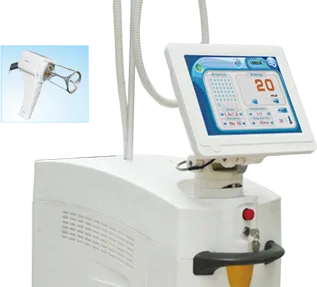
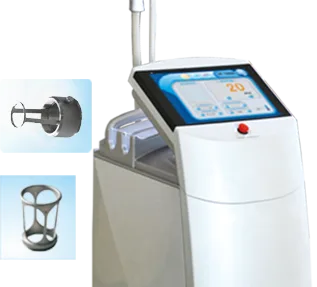
- How many treatment tips ship in the box. Our product documentation for this range describes a fixed-focus lens for the deepest columns, an adjustable zoom lens for shallow or deep peeling, and a roller-type fixed-focus lens for orbital, perioral and nose wing areas.
- Whether the scan pattern set is upgradeable, or frozen at whatever ships on day one.
- Interlock, footswitch and emergency stop working on the demo unit, not promised for the production batch.
- Goggles rated for 1550nm, supplied with the machine. Generic eyewear is not protection.
- Input voltage matched to your market: 220V/50Hz or 110V/60Hz.
- Random scanning rather than sequential firing, so heat spreads instead of piling into neighbouring spots.
Regulatory and commercial terms to get in writing
Paperwork decides whether the deal works in your market at all. The US FDA groups laser products into hazard classes and requires class and output labelling, with higher classes carrying greater injury potential if misused. Devices in this category sit at the top of that scale, so eyewear, controlled access and trained operators aren't optional extras. Get all of this on paper before the deposit leaves your account:
- Regulatory status for your market: CE marking, US FDA 510(k) clearance or national registration, with numbers you can verify yourself.
- Warranty term and exact scope. How many years, and does it cover the fiber source, tips, main board and labour? Get wear parts listed separately.
- Minimum order quantity and unit price at every quantity tier.
- Lead time from deposit to shipment, plus realistic transit to your port.
- Payment terms, Incoterm, and who prepares export documents and import licensing.
Our guide to FDA 510(k) versus CE marking covers what each pathway does and doesn't allow commercially.
1550nm or CO2: which one wins the case?
Non-ablative 1550nm wins on downtime, tolerability and repeat bookings. CO2 wins when a clinic needs maximum change from one session. Different tools. Any distributor worth their margin sells both without slagging off either.
| Factor | 1550nm non-ablative fractional | 10,600nm CO2 ablative fractional |
|---|---|---|
| Tissue effect | Coagulates columns, surface stays closed | Vaporises columns, removes tissue |
| Downtime | Short, mostly redness | Longer, with crusting |
| Sessions | Progressive, usually several | Fewer, stronger per pass |
| Best fit | Rejuvenation, mild to moderate atrophic scars, texture, pores | Deep resurfacing, deeper scars, heavy photodamage |
| Client tolerance | Easier to sit through | More demanding aftercare |
For the three-way view, see our breakdown of CO2 vs Er:YAG vs 1550nm fractional lasers. In clinics that carry both, the pattern repeats: deep scarring and heavy sun damage go to CO2, while the 1550nm platform stays busy with rejuvenation, pores and repeat-friendly scar courses. The non-ablative machine usually has the fuller diary.
What can you honestly promise on acne scars?
Promise gradual improvement across several sessions, and screen scar type before you quote. Wider, shallower atrophic scars respond better than narrow, deep ones, because the narrowest icepick scars often sit below where non-ablative columns do useful work. Clinics that skip that conversation end up refunding people.
Our archived device documentation lists this range's applications as atrophic scars, acne, wrinkles, enlarged pores, thin or fragile skin, stretch marks and facial rejuvenation. Broad menu, good for utilisation, and it means the operator sets energy, density and lens per indication instead of running one house protocol on everyone. Our acne treatment solutions page shows where a 1550nm platform sits alongside other scar workflows.
Sell the course, not the session. A client who books six visits and sees steady change refers friends. A client sold a miracle visit posts a review you can't delete.
Tip life, comfort and the running cost nobody quotes
Judge this purchase on what it costs to keep running, not the sticker price. Two machines with near-identical spec sheets drift a long way apart once they're doing six faces a day. Ask these five questions and write the answers down:
- What's the service life of each treatment tip or lens assembly, and what does a replacement cost landed in your country?
- Is the fiber source field-replaceable, and what warranty covers it specifically?
- How does the platform manage comfort? Look for fine energy stepping, adjustable pulse interval and randomised scanning that avoids stacking heat in one spot.
- What routine maintenance does the air-cooling system need, and how often?
- What training, spare parts stock and remote support come after the sale, and in what language?
Comfort is a commercial feature, whatever your accountant thinks. A busy salon running back-to-back sessions needs a machine the operator can keep tolerable at working settings, because tolerable sessions get rebooked. Weigh tip and source economics against the volume you honestly expect in year one, not the pitch-deck volume.
Send us your checklist and we'll fill it in
You've got the list. Try it on us first. Write to the Pmise sales engineering team for a written spec sheet and quotation on the 1550nm erbium glass fractional laser range, covering five things:
- Full parameter sheet on letterhead: pulse energy and stepping, focal spot range, density and scan-area options, pulse interval, cooling.
- Warranty term and scope, itemised: fiber source, tips and lenses, main board, labour.
- Tip and lens replacement pricing, plus fiber source cost, so you can model running cost before the order.
- MOQ and unit price at every tier, for the configuration you actually want.
- Lead time from deposit, your Incoterm, and the regulatory documents we can supply for your market.
Holding quotes from other factories? Send those sheets too. We'll mark up where the numbers are genuinely comparable and where they quietly aren't.
Frequently Asked Questions
Is a 1550nm fractional laser ablative or non-ablative?
Non-ablative. The 1550nm beam is absorbed by water and coagulates microscopic columns in the dermis while the outer surface stays essentially intact. Healthy tissue remains between treated columns, which is why recovery is usually quicker than after ablative CO2 resurfacing. The trade: more sessions to build a comparable result.
How many sessions do acne scars usually need?
Plan for a course, not a single visit. Non-ablative fractional treatment stimulates collagen remodelling over weeks, so change accumulates. Boxcar and rolling scars generally respond better than narrow icepick scars. Spacing and session count are set by the treating physician from scar type, skin response and healing, so screen scars before quoting a package price.
Does 1550nm work on darker skin types?
It's generally considered a reasonable option across a broad range of skin types, because the wavelength targets water rather than melanin, so the effect isn't driven by skin colour. Settings, patient selection and operator skill still matter. Anyone treating higher-risk skin or working near the eyes needs proper training and correctly rated 1550nm eyewear.
Which specs matter most when comparing machines?
Confirm the wavelength is genuinely 1550nm from an erbium glass fiber source, then check pulse energy stepping, focal spot range, density options and the pattern generator with its available tips. Then weigh tip life, fiber source warranty, cooling and after-sales support. A spec sheet only pays if running costs and support hold up in daily clinic use.
Pmise Technical Team. We manufacture and export light-based aesthetic systems and support distributors and clinics with device selection, specification and operator training.