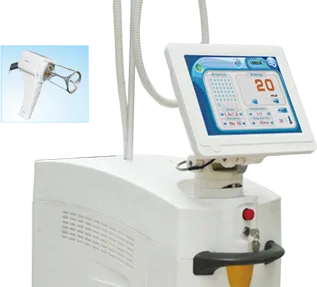
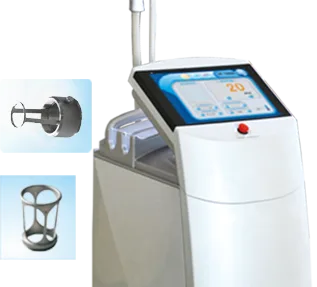
Erbium Glass Fractional Laser (1550nm)
Pmise EF-02
- The target tissue is water, no skin type limit (Fitzpatrick I-VI).
- The output spot diameter is 50-80 um, less thermal ablation and deeper penetration, less side effects.
- Random scanning avoids thermal damage caused by heat accumulation, reducing the pain of the treatment.
- IPG 30W laser device ensures deep penetration and long life tim
- Wrinkles caused by sunlight or early aging wrinkles, wrinkles on lower eyelid, foreTip, cheek as well as crow's feet.
Overview
The Pmise EF-02 is a 1550nm erbium glass fractional laser built for clinics and aesthetic providers that need non-ablative skin resurfacing with a controlled recovery profile. It uses a German IPG fiber laser source and a computer pattern generator (CPG) to place microscopic treatment columns across the skin, making it well suited to wrinkles, acne scars, enlarged pores, stretch marks and general photoaging repair. It is professional equipment intended to be operated by trained clinicians.
Within the wider Erbium Glass Fractional Laser (1550nm) line, the EF-02 is positioned as the safety-focused variant, designed for lighter downtime and a gentle treatment feel and often favoured for darker and more reactive skin. Because the laser targets water rather than melanin, it carries no fixed skin-type limit and can be applied across the Fitzpatrick I to VI range.
For a fuller picture of the technology and how a session runs, see our 1550nm erbium glass fractional laser guide.
How It Works
The EF-02 works on the principle of fractional photothermolysis. Instead of treating the whole surface at once, the beam is split into many tiny high-energy spots that create narrow microthermal treatment zones and leave the surrounding tissue untouched. Those intact islands of skin act as a healing reservoir, keeping recovery shorter and complication risk lower than fully ablative resurfacing.
At 1550nm the laser is strongly absorbed by water, the main chromophore in the dermis. A high-focus lens delivers a focal spot that can be as small as 50 microns, forming microscopic channels roughly 0.12mm wide that reach into the dermis to a depth of around 2mm. The heat deposited around each channel triggers the natural wound-healing cascade: inflammation, proliferation and remodelling. Over the following weeks this stimulates new collagen and progressive dermal rebuilding, so results build gradually rather than appearing all at once.
The CPG uses random (non-sequential) scanning so adjacent spots are not fired back to back. This spreads the thermal load, avoids heat accumulation in one area and helps keep treatment more comfortable. Pulse energy, pulse width, spot density, pattern and scan area are all adjustable, letting the operator tune the setting to the target tissue and body region. Three lens options are available, including a fixed-focal cone for the deepest effect, an adjustable-focal cone for shallow-to-deep peeling, and a roller-type cone for delicate zones such as the orbital area, nose wing and perioral region.
Applications
The EF-02 suits clinics, medical spas and distributors serving skin-rejuvenation and scar-correction demand across a broad patient base, including darker skin tones that are harder to treat with pigment-targeting devices. It is professional equipment and should be used by trained operators following an assessment.
- Fine lines and wrinkles, including periorbital and crow's feet areas
- Atrophic and acne scars, including acne-related texture repair
- Enlarged pores, rough texture and loss of firmness
- Stretch marks and general skin tightening
- Photoaging and overall facial skin rejuvenation
- Milder support for pigmented irregularities such as sun spots and uneven tone
Key Advantages
- Water-targeting 1550nm wavelength with no fixed skin-type limit, applicable across Fitzpatrick I to VI
- German IPG fiber laser source for stable output and long service life
- Very small focal spot with deeper, more precise penetration, so ablation stays limited and side effects are reduced
- Random CPG scanning that avoids heat build-up and improves comfort during treatment
- Adjustable energy, pulse width, spot density, pattern and scan area for treatment tailored to each region
- Three interchangeable lens cones, including a roller type for delicate facial zones
- Non-ablative fractional approach with lighter downtime than fully ablative resurfacing
- Simple, user-friendly interface and air-cooled design for straightforward clinic operation
To evaluate the EF-02 for your clinic or distribution network, contact our sales team to request a quote or distributor pricing. We can arrange a demo, confirm lead times and shipping, share CE and applicable compliance documentation, and discuss OEM and reseller support. Get in touch with Pmise to take the next step.
Specification
| Laser Type | German1550 fiber laser |
|---|---|
| Laser Power | 30W (10W, 20W optional) |
| Pulse Width | 0.067ms-6.7ms |
| Scanning Mode | Random CPG Scanning |
| Pulse Interval | 1ms-100ms (Step 1ms) |
| Guide Light System | Fiber |
| Spot Density | 6x6 spots/cm², 12x12 spots/cm², 18x18 spots/cm², 24x24 spots/cm² |
| Cooling | Air cooling |
| Wavelength | 1550nm |
| Output Mode | CPG |
| Spot Diameter | 50μm-2000μm (continuously adjustable) |
| Pulse Energy | 2mj~200mj (Step 2mj) |
| Spot Graphic | Triangle/ Square/ Rectangle / Rhombus / Round (can be updated to DIY Graphic) |
| Scan Area | 1 cm x1 cm, 2 cm x2 cm, 3 cm x3cm |
| Insurance Standard | Max5A |
| Gross Weight | 50kg |
| Dimensions (after package) | 53x79x143cm3 |
FAQ
What conditions is the Pmise EF-02 best for?
It is designed for non-ablative fractional resurfacing: fine lines and wrinkles, acne and atrophic scars, enlarged pores, stretch marks and general photoaging. Because it targets water in the dermis and stimulates collagen remodelling, it is a texture and firmness tool first. Pigment concerns can improve mildly, but a dedicated device is better when pigment is the main goal.
Which skin types can be treated?
The 1550nm wavelength is absorbed by water rather than melanin, so there is no fixed skin-type limit and the device can be used across Fitzpatrick I to VI. The EF-02 is positioned as the safety-focused variant of the line and is often preferred for darker or more reactive skin. A patient assessment and, where appropriate, a test spot are still recommended before a full session.
How many sessions are needed and is there downtime?
Collagen rebuilding is gradual, so a course of sessions spaced several weeks apart is typical, with the exact number depending on the indication and skin condition. As a non-ablative fractional treatment it generally involves lighter downtime than fully ablative resurfacing, though the operator sets expectations case by case. Session parameters and intervals are decided by the treating clinician.
What training and support come with the device?
The EF-02 is professional medical-aesthetic equipment and must be operated by trained clinicians. Pmise provides operator guidance, recommended treatment parameters and after-sales support, with warranty terms confirmed at purchase. Operators should follow local regulations, use the supplied eye protection and observe applicable laser-safety practice when running the system.