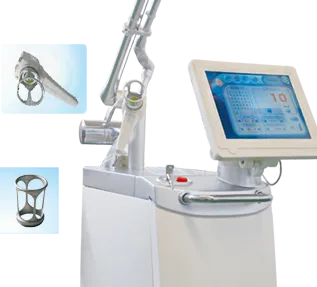
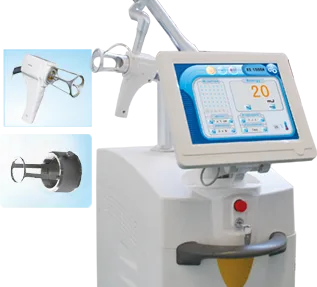
Start here: how to choose a fractional CO2 laser is really a question about the laser source. Almost every 10,600 nm resurfacing system runs on either an RF-excited metal tube or a sealed glass tube. That one component sets beam quality, energy stability, warm-up behaviour and how long the machine keeps paying for itself.
Get the source right and the shortlist gets easy. This guide is for clinic owners, distributors and med-spa operators who sign the order and live with the machine. If you already want an RF-excited platform, start with the Ultrapulse CO2 fractional laser range at 10,600 nm.
What does a fractional CO2 laser actually do to skin?
It ablates skin in a grid, not a sheet. Columns of 10,600 nm light go into the tissue while untreated skin is left between them, and those bridges make recovery faster than old full-field resurfacing. Ramsdell, in Seminars in Plastic Surgery (2012), explains that CO2 lasers emit at 10,600 nm and that this wavelength is strongly absorbed by tissue water, so the beam vaporises the surface and lays down a controlled zone of heat beneath it. The same review describes how heat-denatured collagen contracts and how new collagen keeps forming for months.
The principle goes back further. Anderson and Parrish set it out in Science in 1983: pick a wavelength your target absorbs, keep the pulse short enough, and you spare what surrounds it. For a CO2 device the target is water, which sits everywhere in skin, so control comes from pulse structure, spot size and placement. Beam consistency beats the biggest wattage number on the brochure.
RF-excited vs glass tube CO2: which source should you buy?
For a clinic treating patients every week, RF-excited is the better buy. It holds energy steady, puts down spots of even size, and it lasts. Glass tube wins on price and loses almost everywhere else. Our engineering archive compares the two directly: RF-excited output stays stable through a long run while glass tube energy falls away noticeably from the beginning of the pulse train, and RF focal spots are far more evenly distributed in size and density.
Why does that matter on a treatment day? A spot that drifts in size and energy is a treatment you can't reproduce. Your junior operator uses the same parameters as your senior one, and the skin responds differently. Buyers underestimate repeatability.
| Factor | RF-excited (sealed metal tube) | Sealed glass tube |
|---|---|---|
| Spot uniformity | Consistent spot size and density | Size and density vary noticeably |
| Energy stability | Steady across a long treatment | Drops off through the pulse train |
| Pulse-to-pulse power | Pulses closely matched | Swings high and low |
| Service life | Longer, years of clinic use | Shorter, replaced sooner |
| Cooling and upkeep | Air-cooled and sealed, no water loop | Often water-cooled, more routine attention |
| Warm-up before first case | Quick, nothing to warm up | Cooling loop needs to settle first |
| Purchase price | Higher | Lower |
A note on warm-up. Our device manuals describe the air-cooled RF platform as running with no water flow and no cooling maintenance. That's what you want in a room that opens at nine with a patient booked for nine fifteen.
How long does each laser source last?
Expect a meaningfully longer working life from the RF-excited source. That's where the higher price gets paid back. Our engineering archive states an RF-excited CO2 source can be used for at least three years, while a glass tube may give one or two before performance falls off, and it puts glass tube life in the hundreds of operating hours against tens of thousands for RF. Those are manufacturer figures, not independent test data, so treat them as a guide and hold your supplier to a written number.
Three questions for any vendor, in writing:
- What is the expected source life at my treatment volume, stated in hours or years?
- What does a replacement tube cost, landed, and what's the lead time?
- Does the warranty cover the laser source separately from the chassis, and for how long?
A cheap machine with a short-lived tube quietly becomes the expensive one. This matters more than the sticker price.
Beam quality, scanning modes and power: what to check on a demo
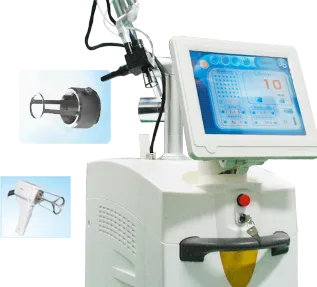
Beam quality decides how even the treated columns look. Scanning decides how they get laid down. Our device manuals for the Pmise CF-01 describe a randomised computer pattern generator scan with selectable spot densities and several pattern shapes, alongside continuous-wave, ultrapulse and fractional output on the same platform. Randomised placement spreads the thermal load rather than stacking heat in neighbouring spots, the practical difference between a comfortable pass and an angry one.
Power and spot range should follow the work you actually do, not the number that looks best in a quote. The documentation for the Pmise CF-01 lists 10,600 nm at a maximum output of 30 W, with 10 W and 20 W options, a continuously adjustable focal spot from roughly 80 to 2000 microns, sub-millisecond to several-millisecond pulse durations, plus selectable treatment areas and spot densities, all through an articulated arm. The Pmise CF-02 documentation puts the smallest adjustable spot near 50 microns.
Read those numbers as depth control. A small focal spot concentrates energy and drives a deeper column; a larger spot spreads it for a shallower pass. Our device manuals list three lens options: fixed-focus for the smallest spot and deepest ablation, adjustable-focus for moving between shallow and deep peeling, and a roller-type fixed lens for tight areas around the eyes, mouth and nose wings. If scars are a big part of your book, interrogate that lens set. Our scar treatment solutions page maps column depth onto different scar types.
Do you need the gynecological handpiece?
Buy it only if you'll genuinely offer the service, with proper medical oversight and under your local rules. CO2 platforms in our technical archive list gynecology among their applications, alongside ENT, neurology and general surgery, and many fractional systems offer a dedicated intravaginal handpiece. Those surgical uses belong in hospitals, not on a med-spa menu.
Internal treatment is a regulated medical procedure, not a bolt-on upsell. Energy delivery, operator training, consent and record-keeping all differ from facial resurfacing, and claims here should stay conservative. If intimate wellness isn't on your list, leaving the handpiece off keeps the quotation and the compliance file simpler.
Which certifications must the laser have?
Check the paperwork before you check the price. A fractional CO2 laser is a medical device in most markets, and the wrong file leaves your shipment at customs or your clinic carrying the liability.
In the United States, the FDA generally handles aesthetic laser systems as Class II devices cleared through the 510(k) premarket notification route, where the manufacturer shows substantial equivalence to a legally marketed device. In the European Union, Regulation (EU) 2017/745 applies; the device must carry a CE mark, and under Article 13 the importer has to verify that marking, the authorised representative and the registration before placing it on the market. Rules vary by country, so check yours.
- CE certificate under EU MDR 2017/745 for the exact model, plus a named EU authorised representative.
- FDA 510(k) clearance number and cleared indications, checkable in the FDA's public database.
- Device classification in writing, so you know the record-keeping burden.
- Import and health-authority registration steps for your own market.
- Names that match across the certificate, the invoice and the plate on the machine. Mismatched documents are a red flag.
Older marketing material in our archive carries CE and national medical-device registration marks. Certificates are model-specific and they expire, so ask us for a current one covering your model and market before you pay a deposit.
A buying sequence that works
- Write down your top three indications. Resurfacing, scars and tightening all pull toward precise depth control.
- Choose the source. RF-excited for real throughput and multi-year life. Glass tube only for light, budget-bound use.
- Confirm modes and scanning. Continuous, ultrapulse and fractional output, plus randomised scanning with adjustable density.
- Right-size power and spot range. Check the power options and full focal spot range against your case mix.
- Clear the regulatory gate. CE or 510(k) for the exact model, plus your own import and registration steps.
- Price the lifecycle. Source life, tube replacement cost, warranty split, training, parts lead time. In writing.
- Add only the handpieces you'll use. Roller and zoom lenses for facial work; the gynecological handpiece only if that service is real.
Get the documents before you sign
Shortlisting right now? Send the Pmise technical team your monthly case volume and target market, then ask for four things on the exact model you're pricing: the full specification sheet, the certification file for that market, a written source-life estimate at your volume, and current pricing for a replacement laser source and consumables. Want to watch the scanner and lens set run first? Ask for a demo on that model, not a generic video.
Still weighing wavelengths? Our CO2 vs Er:YAG vs 1550 nm comparison and our guide to ablative and non-ablative fractional lasers put CO2 in context.
Frequently Asked Questions
Is an RF-excited CO2 laser worth the higher price?
For a working clinic, usually yes. Our engineering archive records that an RF-excited source holds energy steady through a treatment and can be used for at least three years, against roughly one to two years for a glass tube. Steadier pulses give results you can reproduce, and a longer-lived tube spreads the extra cost across far more treatment hours.
What wavelength do fractional CO2 lasers use?
Every CO2 laser, fractional or not, emits at 10,600 nm. Ramsdell notes in Seminars in Plastic Surgery (2012) that this wavelength is heavily absorbed by tissue water. That absorption lets the beam vaporise the surface and deposit controlled heat below it, producing both the ablative effect and the collagen remodelling that scar work depends on.
Does a glass tube CO2 laser give worse results?
Not automatically. It's just harder to keep consistent. Glass tube output tends to swing more from pulse to pulse and its spot size and density are less uniform, so the same settings won't always give the same skin response. An RF-excited source with a good scanner makes protocols easier to reproduce across sessions and staff.
Can one machine handle both scars and general resurfacing?
Yes, provided it has the range. A platform with continuous, ultrapulse and fractional modes and a genuinely adjustable focal spot moves from deep scar columns to a light full-face pass. Depth control decides it: smaller spot for deeper scar work, larger spot or lower density for gentle passes. Check spot range and lens options against your cases.
Written by the Pmise Technical Team. Pmise manufactures 10,600 nm fractional CO2 and other light-based aesthetic systems and supports clinics and distributors worldwide with specification guidance, operator training and after-sales service.