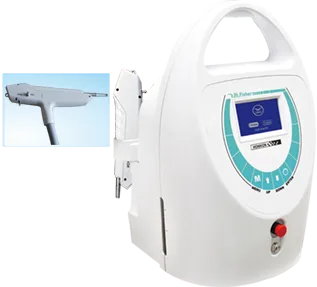
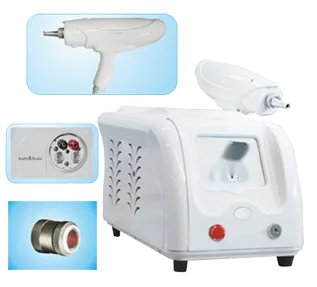
A tattoo removal machine built on a q-switched Nd:YAG laser clears ink by firing nanosecond pulses that shatter pigment into fragments the body can carry away. That's the core of it. Two wavelengths, 1064 nm and 532 nm, cover dark ink and warm ink from one platform. Below: the mechanism, the colour logic, session planning, and the buying checklist.
How does a q-switched Nd:YAG tattoo removal machine work?
It breaks ink apart mechanically. Nothing is burned off. The laser packs very high peak energy into an ultra-short nanosecond pulse, the pigment absorbs it, and the particle responds with an instantaneous blast. Our device manuals describe what follows: the pigment shatters, some fragments are bounced out through the skin, and the rest end up small enough for phagocytes to engulf and the lymphatic system to clear over the following weeks.
Which is why one pass never erases a tattoo. It lightens it. Clearance is your client's biology working over weeks. Every serious q-switched Nd:YAG laser is engineered around that single idea.
Why does the pulse have to be that short?
Because ink particles are tiny, and tiny things cool fast. Let the pulse run longer than the time a particle needs to shed its heat and that heat leaks into normal skin. Burns and scars follow. Anderson and Parrish set out the principle in 1983 in Science: selectively absorbed light, kept brief enough, damages a pigmented target while sparing what surrounds it. For tattoo ink, that means nanoseconds. More in our piece on selective photothermolysis.
The q-switch exists to compress the laser's energy into a pulse short enough to crack pigment instead of cooking the skin.
Which wavelength removes which ink colour?
Match the beam to the ink: 1064 nm for dark work, 532 nm for reds and warm tones, both across a course for the muddy colours between. That mapping comes from the absorption guidance in our technical archive, and it's why a dual-wavelength head is the workhorse for mixed tattoos.
| Wavelength | Typical ink targets | Why it suits them |
|---|---|---|
| 1064 nm | Black, blue, blue-black, green-blue | Deeper penetration, strongly absorbed by dark pigment |
| 532 nm | Red and warmer tones | Absorbed well by red pigment, sits more superficially |
| Both, across sessions | Coffee, brown, multicolour pieces | Layering reaches inks neither wavelength resolves alone |
Now the part your clients won't want to hear. FDA consumer guidance states plainly that lighter colours such as yellow, green and red are harder to remove than dark blue and black. Say that at the consultation, not after session four when a green leaf is still sitting there. Our tattoo removal solutions map the same platform across pigment work.
How many sessions does laser tattoo removal take, and how far apart?
Plan a course, never a single visit. The FDA says it may take six to ten treatments to remove a tattoo. The American Academy of Dermatology puts the range wider, roughly one to ten sessions, and recommends about six weeks between them so the skin heals and the ink absorbs. A clinician's report in our archive documented a tattoo cleared with 1064 nm and 532 nm over about ten treatments.
Rushing the interval speeds up nothing, and treating inflamed skin raises your complication rate.
- Consult and record. Skin condition, pain tolerance, expectations, contraindications. Photograph the tattoo.
- Pick the wavelength for the dominant ink colour in the area you're treating that day.
- Test first. Our manuals recommend starting low, firing three to five shots, watching the response, then working the energy up.
- Treat to endpoint with the tip perpendicular to the skin and shots overlapped only slightly.
- Aftercare and rebook. Sun protection, no scratching, scabs left to fall off by themselves.
What should you look for when buying a tattoo removal machine?
Two lists, not one. Optics decide whether the machine clears ink. Commercial and regulatory terms decide whether you can legally sell it, service it and re-order it.
The technical shortlist
- Both 1064 nm and 532 nm from one device, so you aren't turning away red and brown work.
- Nanosecond pulse width, the physical requirement for photoacoustic fragmentation, not a spec-sheet ornament.
- Continuously adjustable spot size and energy for varying ink depths and skin tones.
- A heat-tolerant handpiece and cooling rated for long sessions. A machine that overheats after an hour costs more in cancelled appointments than it ever saved at purchase.
- A red aiming beam, because placement on a busy Saturday depends on seeing where each shot lands.
- A shot counter on the panel, so lamp hours and service intervals are traceable, not guessed.
The commercial checks a distributor can't skip
Send these as written questions with your RFQ and keep the answers on the pro forma invoice. A supplier who dodges one is telling you something.
- Clearance for the destination market. In the EU, ask for the CE Declaration of Conformity plus the EMC and electrical safety reports behind it, and check whether it's a medical CE or a general product CE. For the US, ask about FDA 510(k) clearance on that exact model; a CE file counts for nothing there. Our archive holds EMC and low-voltage certificates covering the Nd:YAG line, but certificates get renewed, so ask for current dated copies. See medical CE versus standard CE.
- Warranty scope and length, in writing. The period, what it covers, what it excludes, and who pays freight on a warranty part. Lamps and optics are commonly treated as consumables rather than warranty items, so confirm that with the manufacturer rather than assuming.
- Consumable life and replacement cost. The flashlamp is the wear part on a lamp-pumped q-switched laser. One manual in our engineering archive puts xenon lamp life at roughly 1,000 working hours, after which energy falls off and the lamp should be replaced. Ask the rated life for your model, the unit price, whether spares ship in the crate, and the replacement lead time.
- MOQ, lead time and paperwork. Confirm minimum order quantity, lead time from deposit, and the export document set: commercial invoice, packing list, certificate of origin, test reports, and a manual in your operators' language. Fix voltage and plug type before production starts.
- OEM and private label. Can the badge, panel text, manual and packaging carry your brand? What artwork does the factory need, and does branding shift MOQ or lead time? Our OEM and ODM guide covers what factories accept.
- Training and certification support. Parameter charts, protocols, remote commissioning, video or on-site training. A distributor lives or dies on whether end users succeed, so ask who provides this, in what language.
Price still matters. It just isn't the whole number. Over a working life you also pay for lamps and optics, service labour or shipped spares, and revenue lost while a room waits on a part. A cheaper unit that strands you for two weeks whenever something fails is the expensive one. Quote machine, spare-parts kit and service together, then compare totals. More in our running costs and consumables and importing guides.
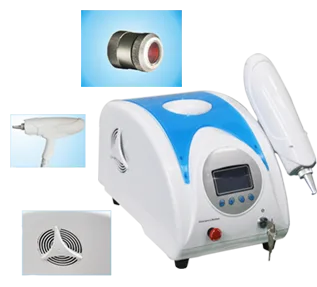
Our QN series is built against both lists. The compact Pmise QN-06 is a useful reference: dual-wavelength q-switched Nd:YAG at 1064 nm and 532 nm, a continuously adjustable 1 to 5 mm spot, 10 to 20 ns pulse width, 1 to 5 Hz repetition rate, water and air cooling, and a net weight around 7 kg, according to our engineering archive. The Pmise QN-09 and QN-07 sit alongside it; our guide on how to choose a q-switched Nd:YAG laser compares them.
| Feature | What to demand | Pmise QN-06, from our archive |
|---|---|---|
| Laser type | Q-switched Nd:YAG | Q-switched Nd:YAG |
| Wavelengths | 1064 nm plus 532 nm | 1064 nm, 532 nm |
| Spot size | Adjustable range | 1 to 5 mm, continuous |
| Pulse width | Nanosecond | 10 to 20 ns |
| Repetition rate | Adjustable, multi-Hz | 1 to 5 Hz |
| Cooling | Sustained, not intermittent | Water and air |
| Portability | Fits the room | Around 7 kg |
Building your own comparison sheet? Request the full Pmise QN-06, QN-07 and QN-09 spec sheets plus a distributor quotation, and name your destination market so we attach the matching certificate copies.
Who shouldn't be treated, and how do you keep sessions safe?
A real exclusion list applies here. Our device manuals exclude or flag:
- Anyone with a cardiac pacemaker or an internal defibrillator.
- Pregnant women.
- Treatment areas with broken skin, active herpes, malignant lesions or scars.
- Severe diabetes, hypertension, heart disease or epilepsy.
- Recent functional-cosmetic treatment, or vascular surgery on the area in the past couple of months.
Eye protection isn't optional. The 532 nm beam is visible green light and will damage an unprotected retina, so our manuals specify goggles covering 200 to 1080 nm for the operator, plus eye patches or goggles for the client. Dry the treated area before you fire; surface moisture bleeds energy away and quietly ruins the result. Scarring is uncommon but real, and it tracks with operator technique.
Frequently Asked Questions
Does a q-switched Nd:YAG remove every tattoo colour?
It handles the common ones well. 1064 nm takes on black and dark blue, 532 nm handles red and warm tones, and both together across sessions reach browns. Greens and yellows are stubborn. The FDA notes that lighter colours including yellow, green and red are harder to remove than dark blue and black, so a dual-wavelength platform gives the broadest coverage.
Why can't a tattoo be removed in one session?
Each pulse fragments only part of the ink, and the body then needs weeks to carry those fragments away through the lymphatic system. Treating again early accelerates nothing and raises the risk of side effects. The AAD recommends roughly six weeks between sessions, which is why removal is a course rather than an appointment.
How much does laser tattoo removal hurt?
Most clients describe a thin rubber band snapping against the skin, the comparison the AAD uses too. Each pass is quick, since the pulses last nanoseconds. Numbing cream beforehand and cooling afterwards help, and redness usually settles within days.
What does a distributor need from the factory beyond the machine?
Documents and backup. Current certificates for the destination market, a written warranty with clear inclusions and exclusions, spare lamps and optics at known prices and lead times, manuals and parameter charts in your operators' language, and a named service contact who replies fast. Those decide whether your first machines become repeat orders.
Ready to specify a unit? Tell us your target market, case volume and branding needs and our engineers will come back with a configuration, a treatment-protocol pack and pricing, spare-parts and training terms included.
Pmise Technical Team. We manufacture q-switched Nd:YAG and light-based aesthetic systems and support clinics, med-spas and distributors worldwide with training, spare parts and service. This article is educational, not a substitute for clinical training or local regulatory advice.