
Pigment Treatment
Tattoo
Laser tattoo removal works by shattering implanted ink into fragments small enough for the body to carry away itself. The pigment sits in the dermis, far below anything a cream reaches. Q-switched lasers fire nanosecond pulses that the ink absorbs and breaks apart. Clearance is gradual, never instant.
What a tattoo is and why it stays put
A tattoo is colorant deposited into the skin, deliberately with a needle or through trauma, and road rash leaves the same mark. The skin disease atlas in our engineering archive puts the histology plainly: pigment granules sit at different depths through the epidermis and dermis, often lodged in connective tissue around dermal vessels. Plenty of it sits deep. Colour fades slowly across years, so an old tattoo and a fresh one behave differently under identical settings.
That same atlas flags what clinics forget. Tattoos can provoke granuloma and keloid formation. A raised, nodular or persistently itchy lesion needs a dermatologist's assessment, possibly a biopsy, before any laser touches it.
How Q-switched lasers clear ink
The governing principle is selective photothermolysis, set out by Anderson and Parrish in Science in 1983. Deliver energy in a pulse shorter than the target's thermal relaxation time and heat stays trapped in the target instead of bleeding into nearby tissue. Ink particles are microscopic, so their relaxation time runs in nanoseconds. Hence Q-switched cavities.
Our device manuals describe the same sequence across every generation: the pigment absorbs the pulse, a blast follows, the particle shatters. Some debris is ejected through the skin. The rest is engulfed by phagocytes and cleared by the lymphatic system. That pressure-driven fracture is the photoacoustic effect, mechanical rather than slow cooking. A long-pulse laser at the same wavelength heats ink instead of fracturing it, which burns skin and leaves the design behind. Our comparison of Q-switched versus picosecond tattoo removal goes further.
Matching wavelength to ink colour
No single wavelength clears every ink colour. Each pigment absorbs a different part of the spectrum, and the American Academy of Dermatology states outright that one laser cannot remove all colours. FDA guidance ranks them bluntly: blue and black easiest, green, red and yellow hardest.
| Ink colour | Wavelength | What to expect and what to watch |
|---|---|---|
| Black, blue-black, dark blue | 1064 nm | Deepest penetration of the Nd:YAG pair. Reaches deposits shorter wavelengths miss. |
| Red, orange-red | 532 nm | Frequency-doubled output, strongly absorbed by red pigment and shallow ink. |
| Brown, coffee, tan | 1064 nm and 532 nm | Mixed pigment. Our archive plans multi-pass cases across sessions. |
| Green, blue-green | 694 nm or 755 nm | Ruby and alexandrite sit closer to green absorption. Outside a dual-wavelength platform. |
| Yellow, white, flesh-toned and pastel shades | No reliable option. Treat as a hazard, not just a poor responder | Absorption is weak, and the pigment may darken rather than fade. Our archive lists ink that has changed colour among the outcomes hard to clear, so a darkened patch leaves the client worse off. Test spot first, every time. |
Treatment protocol and what to expect
Plan a course, not an appointment. FDA guidance describes typically six to ten treatments depending on size and colours, with a few weeks of healing between. Results vary by depth, pigment chemistry and skin type. Ink density, amateur versus professional work, the mark's age and any cover-up all move the number.
Here's the sequence our manuals set out. Consult, photograph, record. Run three to five shots at low energy and read the response before committing to a full session. Raise energy in steps. When treated pigment lightens or frosts, fluence is adequate.
- Hold the handpiece at 90 degrees, overlapping each spot by about one third.
- Dry the area first. Moisture drains energy and quietly wrecks the result.
- Larger spots penetrate deeper at matched fluence. For dermal ink, stay above 2 mm.
- Operator and patient both wear protection. Goggles rated 200 to 1080 nm cover both lines.
Recommended Pmise equipment
Tattoo work needs peak power, not average power. That drives the purchase. Browse the Q-switched Nd:YAG laser range for the platforms built for it.
Our articulated-arm systems run dual 1064 nm and 532 nm output at roughly 6 ns, a 1 to 7 mm adjustable spot, single-pulse energy to 800 mJ at 1064 nm and 400 mJ at 532 nm, and 1 to 10 Hz repetition. Compact benchtop units use 10 to 20 ns pulses, a 1 to 5 mm spot and lower pulse energy.
Now the part most brochures leave out. Our engineering notes state that machines under 200 mJ single-pulse energy are not suited to bulk tattoo removal, and reserve them for shallow cosmetic pigment: brows, eyeliner, lip line. Buying underpowered is how clinics collect refunds. The full logic sits in our guide to choosing a Q-switched tattoo removal machine.
A hard caution before you sell this for permanent make-up
Cosmetic tattoo is not simply a smaller tattoo. Flesh-toned, white, pink and beige pigments used for brows, eyeliner and lip line can darken under a Q-switched pulse instead of clearing, on the most visible part of a face. Our archive treats colour-changed brows as a separate case with their own settings, and lists ink that has changed colour among the outcomes hard to clear. So this sequence is not optional here.
- Place one test spot on an inconspicuous part of the design, following the archive's three to five low-energy test shots. Never a full pass on visit one.
- Leave a review interval, then look at that spot again before treating the rest. Ten minutes later is not a review.
- If the area darkens, stop. Don't repeat those settings. Refer for specialist assessment, then rethink wavelength, fluence and whether laser suits the case at all.
- Put it in the consent form: darkening is a recognised outcome for pale and flesh-toned pigment.
- Our manuals also bar lip-line removal within six months of the lip line being applied.
Aftercare, risks and contraindications
Screening comes first. Our manuals exclude cardiac pacemakers or implanted defibrillators, severe diabetes, uncontrolled hypertension, heart disease, epilepsy, pregnancy, and active herpes, broken skin, scarring or malignant lesions in the field. Vascular surgery there within two months rules it out too. Keloid-prone patients need extra caution.
Aftercare is simple and patients still get it wrong. Keep the site out of the sun. Leave it unwashed and untouched for two to three days. Let scabs drop off by themselves, because picking turns a clean treatment into a scar.
Expect pinpoint bumps that settle within hours and erythema that fades over days. Hypopigmentation usually recovers. Post-inflammatory hyperpigmentation tracks with baseline skin colour and is a real risk in darker phototypes, so energy selection by phototype matters. Our notes on Fitzpatrick skin types and laser settings go deeper. Scarring is uncommon but possible, and the FDA is direct: complete removal without scarring is sometimes not achievable.
Educational material for clinics, dermatologists and distributors evaluating equipment. Not medical advice, and no substitute for assessment by a qualified clinician.
Next step: specification, quotation and commercial terms
Ready to price a system? Ask us for the specification sheet and a quotation for the Q-switched Nd:YAG range. Tell us the ink colours you see most, your room and power supply, and your market. Here is what our archive supports today.
- Training and commissioning. Every system ships with an installation manual covering arm, treating tip, power supply, foot pedal and interlock, and our manuals require each operator to be trained in technique and laser safety first. Our service standard is customer training by a technical instructor after purchase, plus phone support. Scheduling is agreed per order.
- Spare parts and lamps. A xenon flashlamp pumps the cavity, put at roughly 1,000 hours of service life in our manuals, so budget it as a consumable, not a fault. Flashlamps, foot switch, power cord and light-protection pedal are supplied as spares. Pricing and stock on request.
- Warranty. Our after-sale terms give one year of free service for failures traced to materials or manufacturing defects under correct use and maintenance. Impact, misuse, poor storage and unauthorised repair fall outside it, charged at part cost. Wording on request.
- Documentation for your market. Our quality archive holds ISO 9001 and ISO 13485 certificates, LVD safety and EMC test certificates for the Nd:YAG line, and signed declarations of conformity. Rules differ by country, so name the market and we'll confirm what we can supply for your filing.
- Lead time, order quantity, freight. Quoted per order, on request. We'd rather put it in writing than guess.
Frequently Asked Questions
How many sessions does laser tattoo removal take?
FDA guidance describes a typical course of six to ten treatments, with a few weeks of healing between each. Dense professional work, deep placement and stubborn colours push the count up, while a faded amateur tattoo in black ink may clear faster. Give a range, then re-assess after the first passes.
Does the photoacoustic effect damage surrounding skin?
Not when the pulse is short enough. Confining energy inside the nanosecond range keeps heat in the ink particle, not the tissue around it. Excessive fluence, poor overlap or a wet surface still injures skin. Technique and training carry as much weight as the specification.
What should a distributor check before quoting a tattoo removal system?
Single-pulse energy at both wavelengths, pulse width, spot range and cooling first. Then lamp life, spare-part supply, warranty length, training and the document set for your market. Our answers sit in the section above, so you can quote without waiting on us. The FDA clears these lasers for use by, or under supervision of, a health care professional.
Recommended Equipment
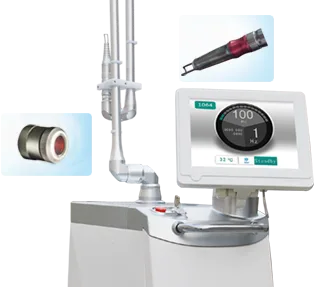
Pmise QE-01
Dual wavelengths (1064nm & 532nm) are convenient to adjust by touching LCD. Multi-spot size (1-7mm) is ideal for a wide…
View details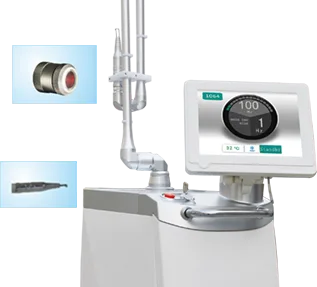
Pmise QE-02
Dual wavelengths (1064nm & 532nm) are convenient to adjust by touching LCD. Multi-spot size (1-7mm) is ideal for a wide…
View details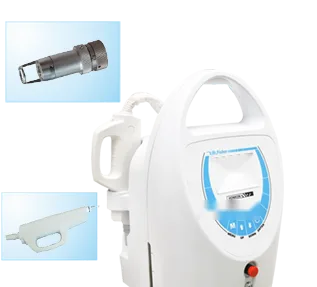
Pmise QN-05
Patented technology of single lamp and dual rods doubles energy output (400mj). Shorter pulse width (6-8ns) than ordina…
View details