Last updated: June 2026. Ask ten suppliers about q-switched nd yag laser price and you'll get ten different answers. Two published guides frame the market: Laser Service Solutions (updated 21 April 2025, accessed June 2026) puts vertical Q-switched machines at US$1,500 to US$3,500 and professional systems at US$20,000 to US$100,000, while Belislaser (no publication date shown, accessed June 2026) quotes US$10,000 to US$60,000 for Q-switched machines generally. Combining those two ranges, Pmise reads the market as roughly US$1,500 to US$3,500 for portable desktop units and about US$10,000 to US$100,000 for professional floor-standing systems. That tier split is our synthesis, not a band either guide publishes. So which tier are you shopping? That question shapes your tattoo removal machine cost more than any spec, and a real nd:yag price still moves with configuration, currency and Incoterms.
How much does a q-switched Nd:YAG laser cost?
Two broad tiers, and they barely overlap. Laser Service Solutions writes that vertical machines with Q-switched or picosecond technology mostly cost US$1,500 to US$3,500, and prices professional systems at US$20,000 to US$100,000. Belislaser gives a single band for Q-switched machines: US$10,000 to US$60,000, with no form-factor qualifier attached. Neither guide publishes a floor-standing band on its own. Reading them together is our own judgement: about US$1,500 to US$3,500 for portable desktop passive units, and about US$10,000 to US$100,000 for professional floor-standing systems.
Both are published list-style ranges, checked in June 2026 rather than quoted to us. What you actually pay moves with currency, components and the Incoterm on the document. Sub-US$1,000 listings exist. They trade away energy stability, build quality and certification to hit that headline. Poor bargain for a clinic that bills by the session.
What determines a q-switched Nd:YAG laser price?
Four variables account for most of the spread. Form factor is the fifth, covered below.
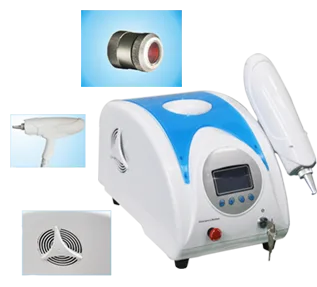
- Single-pulse energy. Per our device documentation, a compact portable such as the Pmise QN-06 delivers up to roughly 200mj in a single pulse, while the floor-standing electro-optic Pmise QE-01 reaches around 800mj at the end of the articulated arm. More energy, bigger power supply, bigger invoice.
- Q-switch type. The shutter inside the resonator is a real cost lever. Passive Q-switching is cheap to build. An electro-optic switch costs more and returns a shorter, steadier, higher-peak-power pulse.
- Handpieces and dual wavelength. A carbon-facial tip and an adjustable spot module are hardware, priced as such. True 1064nm and 532nm output needs a frequency-doubling crystal.
- Brand and certification. CE marking, FDA clearance and documented manufacturing add cost, and cut customs and liability exposure. An uncertified bargain can become the most expensive object in the room.
Portable or floor-standing? That's the biggest price divider
Form factor moves the number more than any individual spec. A portable vertical unit uses the same treatment mechanism as a floor-standing system, just with a smaller power supply, lighter cooling and no arm. The gap between the two is measured in multiples, not percentages.
The table's USD column repeats the tier-level ranges published by the two guides above, checked June 2026, and every cell names the guide it came from. The last column is a unitless index from one Q-switched catalogue in our engineering archive, entry portable set at 1.0. Not a price.
| Tier | Typical configuration | Range published by cited guides (accessed June 2026) | Relative index, our archive catalogue |
|---|---|---|---|
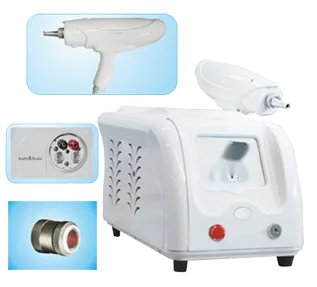
| Entry portable | Compact desktop, dual wavelength, 7kg (Pmise QN-06 class) | US$1,500 to US$3,500 (Laser Service Solutions, vertical) | 1.0x baseline |
| Mid portable | Vertical, extra healing head | US$1,500 to US$3,500 (Laser Service Solutions, vertical) | about 1.25x |
| Higher-energy portable | Single-lamp dual-rod resonator | US$1,500 to US$3,500 (Laser Service Solutions, vertical) | about 1.6x |
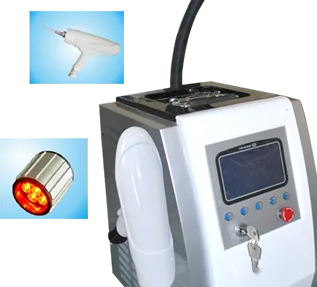
| Top portable | Vertical, touch screen, higher energy (Pmise QN-03 class) | US$1,500 to US$3,500 (Laser Service Solutions, vertical) | about 2.25x |
| Floor-standing EO | Electro-optic switch, articulated arm (Pmise QE-01) | US$20,000 to US$100,000 (Laser Service Solutions, professional); US$10,000 to US$60,000 (Belislaser, Q-switched overall) | about 7x |
Standard or EO Q-switch: how the shutter changes the price
An electro-optic Q-switch raises the sticker, and for demanding pigment work it earns that back. Our passive portables deliver pulses in roughly the 6 to 20 nanosecond band depending on model, per our device documentation, which suits routine pigment and carbon-peel work. The floor-standing Pmise QE-01 pairs a 6 nanosecond pulse with much higher single-pulse energy and an adjustable 1 to 7mm spot.
Who should pay the premium? If your case mix leans on nevus of Ota, multi-colour tattoos, or high daily volume across several operators, the electro-optic system is easy to justify. Running mostly superficial pigment, freckles and carbon facials? A well-built passive unit gives you most of the clinical value for a fraction of the outlay. More on the mechanism in EO vs standard Q-switched Nd:YAG.
What's actually in the box: wavelengths, handpieces and tips
Two quotes for the same model can differ by thousands because one bundles accessories the other charges for.
- 1064nm and 532nm output. Per our device documentation, 1064nm targets black, blue and green-blue pigment plus deeper lesions; 532nm handles red and red-brown.
- Skin rejuvenation tip. Fitted to several of our Q-switched units for carbon facials, a billable service on top of pigment work.
- Spot adjustor, articulated arm, foot pedal, goggles. Standard on most floor-standing systems, sometimes extras on portables. Confirm what's in the crate.
For the full configuration list, see the Q-switched Nd:YAG laser series.
Total cost of ownership, and the arithmetic that settles it
Purchase price is line one of the budget, not the budget. A q-switched Nd:YAG is low-consumable next to IPL or diode systems. Low isn't none.
- Cooling water. Water-cooled units run on purified water, and our device manuals recommend a full change roughly every two months. Costs almost nothing. Easy to forget, and neglect shortens component life.
- Protective fuse tube. Our manuals specify a replaceable fuse in the power socket against unstable mains. Keep spares.
- Tips and optics. Both degrade with shot count. Budget for replacement.
- Operator training. Fluence is energy divided by spot area. Getting it wrong means under-treatment at best, injury at worst.
- Service and downtime. Spare-parts access and shipping time carry real cost.
Now the part most cost articles skip. Every input below is yours, not ours; session fees and treatment counts swing too widely by market for us to publish a typical figure.
- Two-year total = P + (C x 2) + T + S. P is landed price under your Incoterms. C is annual cooling water, tips, optics and fuses. T is one-off training. S is expected service, spares and shipping over two years.
- Per-session cost. Consumable, staff and room cost for one treatment. Your bookkeeping already has these lines.
- Contribution per session = F minus per-session cost, where F is the fee you charge in your market.
- Sessions to break even = two-year total / contribution per session. Divide by realistic sessions per week to get weeks.
Run those four lines for every quote on your desk. A cheap machine with thin spares support and a costlier one with fast service often land closer together than the stickers suggest.
Session volume drives revenue, not only cost. The American Academy of Dermatology states plainly that a laser "cannot safely break down all the layers in 1 treatment session". One machine therefore bills many appointments per client, which is why contribution per session decides the case.
Our breakdown of laser machine running costs details the C and S terms.
How to compare q-switched Nd:YAG quotes
Compare on identical terms or you're comparing nothing. Work this order before anyone signs.
- Match the class first. Same form factor, same Q-switch type. A portable passive unit and a floor-standing EO system aren't competitors.
- Normalize Incoterms and currency. Ex-works, FOB or CIF? Freight, duty and insurance move landed cost a lot.
- Ask for energy at the tip. Single-pulse energy measured at the handpiece output, plus measured pulse duration. Not a headline at the rod.
- List every accessory. Wavelengths, handpieces, rejuvenation tip, spot adjustor, goggles. Included or extra? In writing.
- Check certification and warranty. CE or FDA status, warranty length, parts availability, service response time.
- Price the running costs. Feed each quote into the two-year formula above and compare totals, not stickers.
Get a configured quotation for your clinic
A tier range gets your budget approved. It won't put a machine on your floor. Send us four things: case mix and weekly volume, target tier, destination port, and the certification your regulator asks for. Back comes a quotation itemising model, wavelengths, handpieces and accessories, with the Incoterm on the face of the document, warranty terms and lead time. Use the Pmise enquiry form, or browse the Q-switched Nd:YAG range and name a model.
On the clinical side, our tattoo removal solutions overview and the q-switched versus picosecond comparison help you match machine class to caseload. The physics traces back to Anderson and Parrish's 1983 paper in Science, which showed that suitably brief, selectively absorbed pulses damage pigmented targets while sparing surrounding tissue.
Frequently Asked Questions
What's a realistic budget for a q-switched Nd:YAG laser?
Start from what the guides actually publish. Laser Service Solutions (accessed June 2026) lists US$1,500 to US$3,500 for vertical machines and US$20,000 to US$100,000 for professional systems; Belislaser (accessed June 2026) gives US$10,000 to US$60,000 for Q-switched machines generally. Combining the two, we read the market as roughly US$1,500 to US$3,500 portable and about US$10,000 to US$100,000 floor-standing. That tier split is Pmise's reading, not a published band. Set your machine budget by tier, then adjust for Q-switch type, energy, handpieces and certification.
Why is one Nd:YAG so much cheaper than another?
Usually because it belongs to a different class. A portable passive unit with a smaller power supply and no arm sits well below a floor-standing electro-optic system, though both are sold as q-switched Nd:YAG. Lower single-pulse energy, fewer handpieces, one wavelength or missing certification cut the price too. A quote far below the published tier ranges is a warning sign.
What ongoing costs come with a q-switched Nd:YAG?
Modest, but real. Water-cooled units need purified cooling water changed roughly every two months per our device manuals, plus spare fuse tubes, periodic tip and optics replacement, and operator training. Factor in service access and spare-parts lead time. Against IPL or diode systems, per-treatment consumption is low.
Is a portable Nd:YAG good enough for tattoo removal?
For plenty of clinics, yes. Portable passive units treat tattoos and pigmented lesions effectively. Because removal always needs several spaced sessions, as the American Academy of Dermatology explains, throughput and shot-to-shot consistency matter. Busy practices and stubborn dermal-ink cases do better with a floor-standing electro-optic system.
Pmise Technical Team. Pmise (pameisi.com) builds portable and floor-standing 1064nm and 532nm q-switched Nd:YAG systems in passive and electro-optic configurations; specs come from our device documentation, and the published price ranges cited above were checked in June 2026.