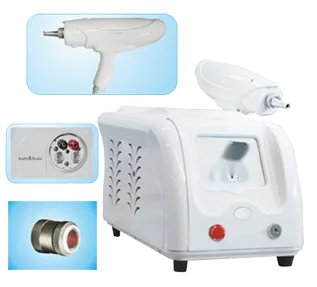
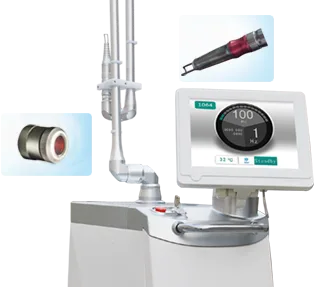
An EO Q-switched Nd:YAG laser uses an electro-optic (Pockels cell) shutter inside the cavity, while a standard Q-switched Nd:YAG relies on an acousto-optic modulator or a passive saturable absorber crystal. Same laser rod, same wavelengths, different gate. The electro-optic gate opens under high voltage and it opens fast, which is why buyers associate it with tighter pulse stability and more usable energy at the handpiece.
Whether the upgrade earns its price depends on what walks through your treatment room door. Here's the physics, the comparison, and where paying more stops making sense.
What does the Q-switch actually do?
Q-switching is a storage trick. The flashlamp pumps the Nd:YAG rod while a shutter holds the cavity closed, so energy piles up instead of leaking out as ordinary lasing. Open that shutter suddenly and the store dumps in one nanosecond-class burst, which shatters ink and melanin rather than warming them. Three shutter types dominate the aesthetic market: acousto-optic modulator, passive saturable absorber, electro-optic Pockels cell.
The clinical logic traces back to Anderson and Parrish, whose 1983 Science paper on selective photothermolysis showed that a pulse shorter than the target's thermal relaxation time confines damage to the target. Our guide to thermal relaxation time covers that. Pigment particles are tiny. They cool in nanoseconds. The shutter has to be quick.
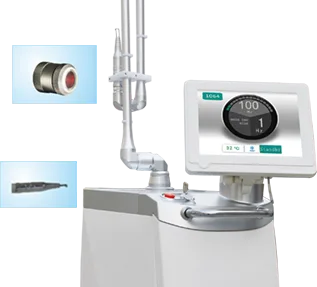
What changes when the shutter is electro-optic?
An electro-optic Q-switch gates the cavity electrically. Apply voltage across the crystal and the polarization of light through it rotates; add a polarizer and you have an optical gate with no moving parts. The RP Photonics Encyclopedia describes it this way, a Pockels cell plus polarizer switching cavity losses from high to low, with switching speed set by the cell's capacitance and driver current. An acousto-optic modulator waits for a sound wave to cross the aperture.
Here's the part vendors gloss over. Pulse width alone often fails to separate the two classes on paper. Our documentation lists 6ns for the electro-optic flagship and 8ns for the second model, while the passive series is specified at 6 to 8ns. Those ranges overlap. The separation is elsewhere:
- Repeatability. An electronic gate fires the same way on shot 1 and shot 4,000. Consistent energy lets a second technician reproduce your protocol.
- Energy at the arm tip. Our engineering archive records the electro-optic flagship at 800mJ per pulse at 1064nm measured at the end of the articulated arm, against 400mJ single pulse for the passive series. Energy at the tip is what matters. Energy at the rod is marketing.
- Repetition rate. Our electro-optic units run 1 to 10Hz; the passive series is listed at 1 to 5Hz. Double the shots per second moves large tattoos and full-face carbon peels along faster.
Faster coverage sounds minor until you're running back-to-back sessions on a Saturday. Then it's the whole schedule.
EO Q-switched vs standard Q-switched: side by side
One clarification first, because this is where sales claims go wrong. Peak power is pulse energy divided by pulse duration. Two lasers putting out the same energy in the same number of nanoseconds have the same peak power, whatever gate sits in the cavity. Our electro-optic flagship doesn't win by firing a dramatically shorter pulse; the documented widths overlap. It wins on delivered energy at the arm tip. Read the table as directional.
| Attribute | EO Q-switched Nd:YAG | Standard (acousto-optic or passive) Q-switched Nd:YAG |
|---|---|---|
| Switching element | Electro-optic Pockels cell plus polarizer, voltage driven | Acousto-optic modulator or passive saturable absorber |
| Gate speed | Fast, set electronically by the driver | Slower; limited by acoustic transit or crystal recovery |
| Pulse-to-pulse shape consistency | High, gate timing is electronically controlled | Adequate, with more variation over a long session |
| Pulse duration (our documentation) | 6ns and 8ns across the two models | 6 to 8ns |
| Single-pulse energy at arm tip (our documentation) | 800mJ at 1064nm on the flagship | 400mJ at 1064nm single pulse |
| Peak power delivered in practice | Higher, because arm-tip pulse energy is about double at a comparable nanosecond pulse width | Lower, following from the smaller documented single-pulse energy |
| Repetition rate (our documentation) | 1 to 10Hz | 1 to 5Hz |
| Best fit | High-volume clinics, dermal pigment, dense multi-colour ink (higher price) | Routine pigment, carbon peel, lower case load (lower price) |
Does the beam profile come with the Q-switch?
No, and this is where buyers get misled. Beam shaping is a separate engineering decision from the shutter. Our documentation for the electro-optic flagship describes a flat-top-cap type spot with homogenous energy, contrasted against a Gaussian spot, plus a spot regulator that holds a stable diameter across settings. A Gaussian spot spikes in the middle, and the middle is where you get a blister.
Several standard models also ship with a homogenised beam. If uniform energy matters to you, ask about the profile directly.
When is an EO Q-switch worth the extra cost?
Buy electro-optic when repeatability and throughput are business problems, not preferences. Multiple operators on one device, dermal pigment such as nevus of Ota, dense or multi-colour ink, a booked-out schedule: there a steadier, harder-hitting pulse pays for itself in fewer redo sessions.
- Dermal pigment or stubborn ink weekly, or occasionally? Weekly points to electro-optic.
- How many technicians touch the machine? Past two, pulse stability stops being academic.
- Daily volume? Under a handful of pigment cases a day, the higher repetition rate is wasted capacity.
- Mostly carbon peel, freckles and superficial lentigines? A solid standard unit handles that comfortably.
Both classes sit in the same nanosecond neighbourhood, so the lever you are really pulling is delivered energy, not pulse width. More peak power pushes the interaction toward photomechanical fragmentation instead of bulk heating. Heating burns skin. Fragmentation clears pigment.
How the Pmise line-up splits
We build both classes, so you can match the shutter to your case load.
- Electro-optic family. The EO Q-Switched Nd:YAG Laser range holds two models. Pmise QE-01 is the flagship: homogenous flat-top-cap spot, 800mJ at the arm tip, continuously adjustable 1 to 8mm spot. Pmise QE-02 is the accessible option, same dual 1064nm and 532nm output, slightly smaller spot range.
- Standard family. The Q-Switched Nd:YAG Laser range is broader, nine models from the portable Pmise QN-09 up to units with homogenised beams and multi-pulse output. Dependable pigment, tattoo and facial work at a lower entry price.
Both families emit 1064nm and 532nm from one platform. The 1064nm beam reaches deeper pigment; frequency doubling gives 532nm for shallow red and brown targets. You're choosing shutter technology, not a different mechanism. Weighing nanosecond against picosecond instead? Read our Q-switched vs picosecond comparison.
What to check before you sign the order
Verify these on paper, then again in a live demo:
- Where pulse energy is measured. Ask for the value at the handpiece output, with the meter named. A figure quoted at the rod isn't what reaches skin.
- Measured pulse width, not nominal. Ask for the oscilloscope trace.
- Spot size and profile. Continuous adjustment beats fixed steps. Ask outright: Gaussian or homogenised?
- Repetition rate under sustained use. A machine that hits 10Hz for ten seconds then throttles isn't one.
- Safety classification and interlocks under IEC 60825-1, plus the eyewear optical density supplied for both wavelengths.
Specs get you a shortlist. Paperwork gets you a working machine. Settle the commercial side before the deposit leaves your account:
- Certification and registration. Ask for the CE declaration of conformity for the exact model, not the range, then check how your own regulator classifies a nanosecond Q-switched Nd:YAG. Sold freely in one market, it can be restricted to licensed practitioners in another. Our note on FDA 510(k) versus CE shows where the paths diverge.
- Warranty and after-sales. Pmise equipment carries a one-year warranty from receipt and acceptance, with in-period maintenance costs on us unless the damage is operator-caused. Servicing continues afterwards on a lifetime maintenance basis; terms sit on our service page. Get whatever a supplier promises into the contract.
- Operator training. Our technical instructors train your team after purchase at no charge, with phone support afterwards. Ask for training built around your real case mix.
- Lamps, parts and maintenance. Ask what a replacement flashlamp costs landed, how fast it ships, and who may fit it, since our manuals tell operators never to open the shell. The manual also asks for cooling water changes roughly every two months. Over five years, that beats the sticker price for importance.
- Lead time, MOQ and distributor terms. Configuration, mains voltage and plug standard move the build schedule, so get the shipping date onto the proforma invoice. Distributors should fix territory, first-order quantity and price break too.
Your next step. Tell us which class you're leaning toward and we'll send specifics, not a brochure: the arm-tip pulse energy report and pulse-width trace for the model you name, the CE declaration, warranty and training terms in writing, and a quotation with lead time. Name Pmise QE-01 or QE-02 for electro-optic, Pmise QN-09 for standard. Send the request here, or compare the EO and standard ranges yourself.
Frequently Asked Questions
Is EO Q-switching the same thing as picosecond?
No. Electro-optic describes the shutter, not the pulse regime. Our electro-optic units are nanosecond devices, documented at 6ns and 8ns. Commercial picosecond aesthetic platforms are typically quoted in the few-hundred-picosecond range, so the real gap between the two device classes is roughly an order of magnitude. The 1000:1 figure you sometimes hear is just the unit relationship (1 nanosecond equals 1000 picoseconds), not the spec gap between the machines. An electro-optic gate improves gating speed and consistency. It doesn't make a device picosecond. Read the quoted pulse duration.
Can a standard Q-switched Nd:YAG still remove tattoos properly?
Yes. Nanosecond Q-switched Nd:YAG lasers have been the workhorse of tattoo and pigment clearance for decades, and clinical reviews report meaningful clearance over a course of treatments. Multiple sessions are the norm either way, and outcomes vary with ink colour, depth and skin type. Electro-optic just gives more headroom on dense targets.
What does pulse stability mean in practice?
It means shot 400 delivers what shot 4 delivered. An electro-optic gate is timed electronically, so drift across a long session stays small, tissue response is predictable, and a written protocol transfers between operators. When pulses wander, the technician compensates on instinct, and that's where uneven clearance creeps in.
Which class should a new clinic start with?
Start standard unless your case book already justifies more. A capable standard unit covers freckles, lentigines, carbon peel and most amateur ink, and the lower entry price shortens payback while you build volume. Move to electro-optic once dermal pigment, dense tattoos or a second operator become weekly realities.
Pmise Technical Team. Pmise (pameisi.com) manufactures 1064nm and 532nm Nd:YAG systems in electro-optic and standard Q-switched configurations for clinics and distributors worldwide; device figures come from our own documentation, physics and clinical principles from the cited sources.