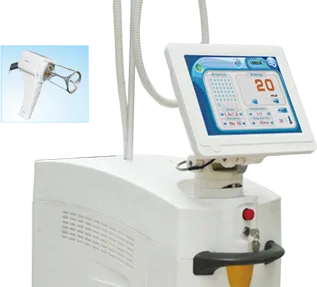
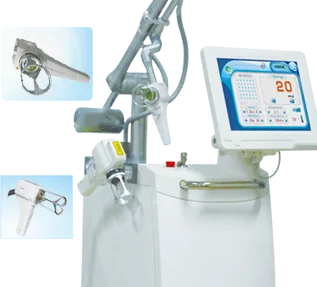
A dual mode fractional laser runs two jobs from one console: an ablative fractional mode that vaporizes microscopic columns of skin, and a non-ablative fractional mode that heats the dermis while leaving the surface intact. One platform, two very different treatments. For most clinics that beats buying two units.
What is a dual-mode fractional laser?
It's a resurfacing platform carrying two laser sources, the operator choosing which one fires. Fractional delivery splits the beam into tiny separated spots, so only a share of the treated area takes energy on any pass. The skin between those spots drives the repair. Manstein and colleagues set that principle out as fractional photothermolysis in Lasers in Surgery and Medicine (2004).
How small is that share? Depends on the device. Our engineering archive lists the 10600nm CO2 platform at 6x6, 12x12 or 24x24 spots per square centimetre over 1x1, 2x2 or 3x3 cm scan areas. The 1550nm erbium glass system states coverage directly: about 1.56 percent of the treated area at 36 spots per cm2, 6.25 percent at 144, and 25 percent at 576. Read that last one again. Even at the densest non-ablative setting documented, three quarters of the skin inside the window is untouched. Those coverage figures describe the non-ablative side only.
Underneath both modes sits the older idea from Anderson and Parrish (1983): pick a wavelength and pulse timing so the energy lands where you want it. Skin is mostly water, and our technical archive plots absorption peaks near 980, 1060, 1480 and 2940 nm. The two wavelengths in a dual-mode cabinet sit at very different distances from that target. Which is the whole reason to own both.
Ablative or non-ablative: what changes in the tissue?
Ablative mode removes tissue. Non-ablative mode doesn't. Our technical archive puts it in temperature terms: around 60 to 65 C gives a thermal effect without necrosis, above roughly 75 C the tissue coagulates, and past about 300 C it vaporizes, leaving a micro-wound ringed by coagulated tissue. A 10600 nm CO2 spot is absorbed strongly enough by tissue water to cross that ablation threshold. A 1550 nm erbium glass spot stays in the heating and coagulation range, down in the dermis, without breaking the surface.
| Property | Ablative mode (CO2, 10600nm) | Non-ablative mode (1550nm) |
|---|---|---|
| Effect on the surface | Vaporizes micro-columns of tissue | Surface stays intact, dermis is heated |
| Strength per session | Stronger | Milder, builds across a course |
| Downtime | Longer, visible healing | Short, minimal social downtime |
| Usual targets | Deeper wrinkles, atrophic and surgical scars, photoaging | Early wrinkles, texture, mild pigment, maintenance |
Neither is the better mode. They're opposite ends of one trade: results per visit against recovery time.
Pulse width is the knob people forget: short pulses leave less coagulated tissue, longer ones leave more.
When is ablative mode the right call?
Reach for CO2 when the goal justifies genuine downtime. It removes tissue and provokes a strong wound-healing response, which is why operators pick it for the hard cases. Our documentation for the 10600nm CO2 fractional platform points its applications at:
- Established wrinkles rather than fine lines
- Traumatic, burn and surgical scars, plus stretch marks
- Skin thinning, laxity and rough, enlarged pores
- Epidermal pigmented lesions such as freckles and age spots
Focal spot size does quiet work here. Our CO2 documentation records a focal spot diameter continuously adjustable from 80 to 2000 micrometres, with the rule stated plainly: a larger focal spot peels shallower, a smaller one reaches deeper. Power density explains it. That rule belongs to focused ablative CO2 output, not to non-ablative treatment.
Ablative work demands better counselling too. Redness, healing time, sun avoidance, say it all before the first pass. Specifications sit on the 10600nm CO2 fractional laser page.
When does non-ablative mode make more sense?
Pick 1550 nm when the patient wants improvement but can't disappear for a week. The surface is spared and only dermal micro-columns are heated, which suits working adults and anything that responds to gradual collagen remodeling. Our erbium glass documentation describes micro-columns roughly 0.12 mm across reaching around 2 mm deep, with applications including:
- Early wrinkles and general skin texture
- Atrophic and acne scarring, plus stretch marks
- Photoaged skin and mild pigment irregularity
The catch is patience. That documentation calls the collagen increase gradual, needing several weeks, so a course of sessions is normal. Say it at consultation, not at review. Our side-by-side on ablative vs non-ablative fractional lasers goes deeper, and the hardware lives on the 1550nm erbium glass fractional laser page.
Dual-mode platform or two dedicated units?
A dual-mode platform trades a little specialization for range, floor space and a single capital decision. Two dedicated machines are each tuned to their job, but you pay twice, house both, and whichever is out of fashion this quarter sits idle.
| Consideration | Dual-mode platform | Two dedicated units |
|---|---|---|
| Upfront cost | One purchase | Two purchases |
| Footprint | One cabinet | Two cabinets, more room |
| Utilization | Higher, one device covers both demand curves | Each idles when the other mode is busy |
| Best fit | Clinics wanting range from one system | High-volume sites specializing in one mode |
Utilization matters more than the sticker price. A machine running six days a week pays for itself; a cheaper one running twice a week doesn't. If your book swings between scar work and downtime-sensitive requests, the combined platform is the easier case. Buyers weighing wavelengths can read our CO2 vs Er:YAG vs 1550nm breakdown.
What buyers should confirm before ordering
Specifications are half a purchase decision. The other half is what happens after the crate arrives.
- Regulatory status, in the right words. Four different instruments get bundled under one word, and that's how buyers get caught out. In the United States the FDA clears devices through 510(k), grants De Novo, or approves them through premarket approval; it does not certify firms or products. Ask which pathway covers the exact configuration and indications you plan to market, then verify it yourself in the FDA's public clearance database. CE marking is a conformity marking declared under the applicable EU regulation, and says nothing about US status. RoHS is restricted-substance compliance. SGS paperwork means third-party test reports, not regulatory permission. Request copies of each for the exact configuration you're quoting. The FDA's Aesthetic (Cosmetic) Devices pages add that regulation turns on intended use, so match the documents to your marketed claims. Our piece on FDA 510(k) and CE marking sets out the difference.
- Warranty and after-sales. One-year warranty from receipt and acceptance, then lifetime maintenance, with 24/7 support contact.
- Operator training. Technical instructors train your staff after purchase, with phone follow-up. Book every operator, not only the owner.
- Consumables and spares. Ask for the expected service life of the CO2 source, handpiece lenses and delivery optics at your session volume, and what's in stock. Our notes on warranty and spare parts list the questions worth asking.
- Installation. Confirm the voltage and frequency build for your market. Our fractional platforms are documented with air cooling and 220V 50Hz or 110V 60Hz mains options.
- Lead time, MOQ and distributor terms. These move with configuration and season, so contact us for current details.
How do you choose the mode chairside?
Match the mode to the indication first, then to the downtime the patient can afford. A working sequence:
- Name the target. Deep scar or set wrinkle leans ablative; texture, mild pigment and upkeep lean non-ablative.
- Ask about recovery days, and get a real answer, not a polite one.
- Agree the session count before treatment, not after the first review.
- Screen for contraindications and current medication before any mode is chosen. Active infection or inflammation in the treatment field, a history of keloid or hypertrophic scarring, pregnancy, recent tanning, photosensitising drugs and recent oral retinoid use all belong on that list. Anything unclear goes to the treating clinician, not to the appointment book.
- Pick the mode, then dial spot size, density and scan area to the site and skin type.
- Book follow-up and spell out sun protection after ablative passes.
Quick pre-treatment checklist:
- Indication confirmed, goal realistic
- Contraindication and medication screening completed and recorded: infection or inflammation in the field, keloid history, pregnancy, recent tanning, photosensitising or retinoid medication
- Wavelength-appropriate eye protection on the patient and on every person in the room, matched to the source in use
- Skin type assessed, pigment risk noted
- Downtime the patient will actually accept
- Mode, spot size and density recorded
- Session count, aftercare and review date explained
None of that replaces clinical judgement. The treating clinician sets final parameters and decides who is suitable; this page is buyer education, not medical advice.
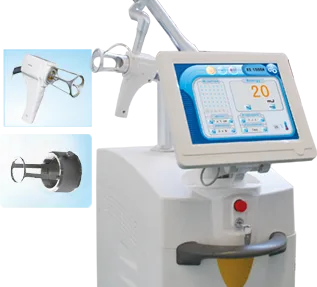
Our combined system is catalogued as the Pmise DF-01. Its product page describes a 1550nm erbium glass fibre laser and a CO2 fractional laser in one platform, the CO2 channel offering continuous, ultra-pulse and fractional output. Configuration details sit on the dual mode fractional laser page.
Next step: ask us for the DF-01 specification sheet and a quote. Send your patient mix, monthly volume and destination country, and we'll come back with the power option, paperwork and a lead time. Start on our contact page.
Frequently Asked Questions
Can one machine really do both ablative and non-ablative treatments?
Both sources sit in one cabinet and the operator selects which fires. Tissue behaviour follows the wavelength, so the ablative channel still removes micro-columns and the non-ablative channel still spares the surface. What varies is the configuration you actually buy: output ceiling, handpiece options, scan performance and duty cycle depend on how the DF-01 is specified. Compare its spec sheet line by line against the dedicated units for the parameters your treatment menu relies on.
Which mode has less downtime?
Non-ablative, clearly. The surface isn't broken, only dermal micro-columns are heated, so recovery is usually limited to short-lived redness and swelling. Ablative treatment removes tissue and leaves small healing wounds, so visible recovery runs longer. It depends on settings, the area treated and how the individual heals. Give patients a range, not a promise.
How many sessions will patients need?
Depends on mode and goal. Non-ablative resurfacing normally needs several spaced sessions, since collagen remodeling builds over weeks rather than days. Ablative treatment does more per visit, so fewer sessions may reach a given result, at the cost of longer recovery. Outcomes vary by indication, skin type and aftercare.
Is fractional treatment safe for darker skin types?
Fractional treatment is used across a wide range of skin types, but pigment risk climbs as settings get more aggressive and as skin gets darker. Many operators start conservative, favour non-ablative parameters and run test spots for higher Fitzpatrick types. A qualified clinician should assess each patient. This is buyer education, not medical advice.
Pmise Technical Team. Pmise builds CO2, erbium glass and dual-mode fractional platforms and configures them for clinics and distributors in export markets.