
Pigment Treatment
Melasma
Melasma shows up as symmetrical brown or grey-brown patches across the cheeks, forehead, upper lip and bridge of the nose. Real melasma treatment pairs strict daily sun protection and topical therapy with cautious, low-fluence 1064nm laser toning. Turn the energy up and you usually make it worse. That rule shapes this page.
What melasma is, and what it is not
Chloasma. The mask of pregnancy. Whatever your patients call it, melasma is an acquired overproduction of melanin on the face. Pigment may sit in the epidermis, deeper in the dermis, or across both layers at once, and that depth quietly decides how a patch behaves under a laser. Our engineering archive says it in one line: melanin increases in the epidermis, the dermis, or both. Patches stay flat, never itch and never clear on their own.
Triggers cluster around sunlight and hormones: pregnancy, oral contraceptives, some medications, and above all ultraviolet exposure. Season swings it too, which is why patches soften in winter and roar back in July. Women make up the large majority of cases.
Watch for look-alikes. Solar lentigines, post-inflammatory marks and dermal melanocytic lesions can all pass for melasma across a room, and each wants different settings. Unsure? Refer before anyone switches a laser on.
Why melasma keeps coming back
This is the part that wears clinics down. You are not removing a spot. You are calming a pigment system that keeps flipping itself back on, and melanocytes in melasma-affected skin react to almost anything: a beach afternoon, heat from a wok, a hormone shift, or the inflammation left by a laser pass that ran too hot. The American Academy of Dermatology describes melasma as a condition that can last years or a lifetime, with sun protection doing much of the work of keeping it away. Our archive lists relapse first among the complications recorded for this work.
Sell control, not erasure. Promise permanent clearance and you are booking next spring's refund argument.
Set that expectation at the consultation, not after session five.
How low-fluence 1064nm toning works
The physics dates back to selective photothermolysis, described by Anderson and Parrish in 1983. Choose a wavelength the target absorbs strongly, fire it in a pulse short enough to trap heat inside that target, and you damage pigment without cooking the tissue around it. For melanin, read nanosecond Q-switched pulses.
Melasma then breaks the usual instinct about power. Rather than shattering pigment with a hard shot, low-fluence toning uses a large collimated spot, very low fluence, a fast repetition rate and gentle repeated passes over a long course. A 2022 systematic review by Lee and colleagues in Medicina gathered the published protocols: roughly 0.5 to 3.8 J/cm2, spots of 6 to 10mm, 5 to 10Hz, sessions one to two weeks apart, usually nine or ten, faint erythema as the endpoint. Pigment lifts a shade at a time.
Why 1064nm instead of 532nm? Depth and safety. The longer wavelength reaches deeper pigment and scatters less through the epidermis, which matters enormously in the darker phototypes melasma hits hardest. Green light at 532nm provokes fresh pigment far too easily in these faces. Clinical feedback in our archive records melasma clearing under 1064nm across roughly a dozen treatments with little or no downtime. Our article on laser treatment for melasma walks through the settings logic and case notes.
Protocol and what to expect
Start with a test patch. Always. Because pigment may be epidermal, dermal or mixed, our device archive insists on treating a trial area of about 0.5 to 1 cm2 first. Treat it, wait, read it. Lightens cleanly? Carry on. Darkens? Stop the laser and go back to topicals and photoprotection.
The table below is a conservative frame, not a prescription. Check every value against your own device manual.
| Parameter | Conservative starting approach |
|---|---|
| Wavelength | 1064nm only. 532nm is not indicated for melasma; the green line belongs to other diagnoses, such as discrete solar lentigines and tattoo ink |
| Spot | Large, collimated, set through a spot regulator |
| Fluence | Low, inside the published toning band (about 0.5 to 3.8 J/cm2) |
| Repetition rate | Roughly 5 to 10Hz, so the handpiece glides |
| Sessions | Published courses commonly run nine or ten visits |
| Interval | One to two weeks; stretch it if skin looks irritated |
| Endpoint | Faint pink flush. No whitening, crusting or bleeding |
| Downtime | Minimal with true low-fluence toning; brief redness |
Results vary with lesion depth and skin type. Epidermal pigment lifts sooner; mixed and dermal melasma moves slowly and rarely clears completely.
Two ways clinics get this wrong
Both failure modes come from pushing, in opposite directions.
Raise the energy and you inflame skin already primed to make pigment. That road leads to post-inflammatory hyperpigmentation (PIH), which can leave a treated cheek darker than it started and linger for months in deeper phototypes. Our archive is blunt about visible pigmentation showing up after treatment in some patients. Hence the faint-flush endpoint, and nothing beyond it.
Now the other direction. Treat too often, for too many sessions, and mottled hypopigmentation becomes your problem instead. The Lee review links those pale specks to excessive cumulative energy. That energy piles up in three familiar ways: fluence set too high, intervals squeezed too tight, a course allowed to run on and on. Our own recommendation is plain. Stop the course at the first sign of mottling, and do not restart it because a patient pushes. No parameter setting escapes both traps. Only restraint does. Our guide to Fitzpatrick skin types and laser settings covers grading phototype first.
- Keep fluence low. Whitened skin means you already overshot.
- Space sessions generously, and never answer slow progress with more power.
- Screen for recent isotretinoin, pregnancy, active infection, herpes history and keloid tendency.
- Photograph every visit under identical lighting.
- Stop the laser if pigment darkens or mottles between sessions.
Recommended Pmise equipment, and what to check before you buy
Melasma rewards a platform you can hold steady at low energy, so you want a controllable Q-switched system rather than a fixed-output box. Machines in the Pmise Q-switched Nd:YAG laser range give you articulated-arm delivery and a spot regulator that keeps large toning passes stable. They also carry a 532nm line, which serves other diagnoses: discrete solar lentigines, tattoo ink. Not melasma.
Ask about the beam profile before you ask about the price. The QN-11 and QN-12 run a top-homogeneous beam at an 8ns pulse width, which spreads energy far more evenly than a Gaussian spot and avoids the hot centre that over-treats an epidermis. Rooms that also handle dermal lesions may prefer the QN-03 or QN-04, pairing a 6 to 8ns pulse with a patented single-lamp dual-rod design at 400mj. Small rooms suit the compact QN-06. Whichever model you pick, insist on fine energy adjustment at the bottom of the range. That is where melasma gets treated.
Commercial questions deserve equal scrutiny:
- Certification. Our records hold an EN ISO 13485 certificate covering design, production, sales and service of Nd:YAG systems, plus low-voltage and EMC testing. Ask for current copies.
- Operator training. Our manuals are explicit: operators must be trained in application technique and laser safety first, and only an authorised technician services the machine.
- Warranty and service. Standard cover in our documentation runs one year against defects in materials or workmanship, misuse excluded, backed by regional service centres.
- Consumables and spares. Our manuals put xenon flash lamp life near 1,000 working hours. Handpieces and cables wear out too.
- Lead time. It moves with configuration and voltage, so we quote per order. Get it on the proforma invoice.
Next step: ask our team for the QN-series spec sheet and our melasma toning parameter guide. We will send certificate copies, training options and spare-part pricing for your market. Want to see the beam first? Request a demo.
Aftercare and long-term maintenance
Aftercare decides whether the course was worth doing. Ultraviolet light restarts the whole process, so daily broad-spectrum sunscreen at SPF 30 or higher is not optional. Hats and shade earn their keep. Park retinoids and acids for a few days after each session, and leave any flaking alone.
Between visits, topical therapy carries much of the load. Dermatology guidance keeps photoprotection and agents such as hydroquinone, tretinoin and azelaic acid as first-line care, with devices layered on top rather than swapped in, and warns that visible change takes months. Plan spaced top-ups alongside continued topicals. Stopping everything at once is the quickest way to watch patches return.
This page is educational information for clinics, dermatologists and distributors evaluating equipment. It is not medical advice, and every treatment decision belongs to a qualified practitioner who has assessed the patient.
Frequently Asked Questions
Can a laser cure melasma permanently?
No, and any supplier telling you otherwise is overselling. Melasma is chronic and relapse-prone, and dermatology guidance frames it as something you control rather than cure. Toning lightens patches, yet pigment creeps back once treatment and sun protection stop. Quote a plan with maintenance built in.
Why is low fluence better than one strong pulse?
Melasma-affected skin overreacts to injury. A pulse hard enough to whiten tissue, crust it or draw pinpoint bleeding creates inflammation, and inflammation here often triggers PIH that leaves the area darker than before. Low-fluence toning nudges pigment down over many soft passes instead. You trade speed for safety.
How many sessions should we quote?
Quote a course, not a number. Published toning protocols usually land around nine or ten sessions at one to two week intervals, adjusted to how the patient responds. Depth drives the spread: epidermal pigment lightens sooner than dermal or mixed melasma, which often responds incompletely.
Recommended Equipment
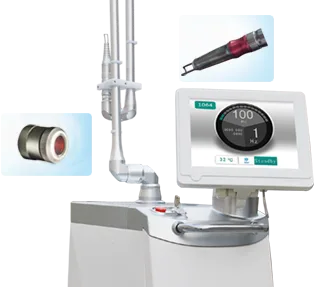
Pmise QE-01
Dual wavelengths (1064nm & 532nm) are convenient to adjust by touching LCD. Multi-spot size (1-7mm) is ideal for a wide…
View details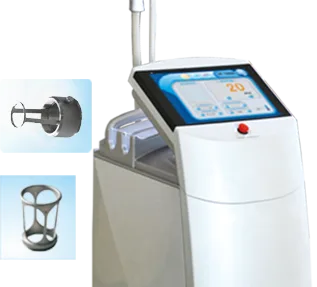
Pmise EF-02
The target tissue is water, no skin type limit (Fitzpatrick I-VI). The output spot diameter is 50-80 um, less thermal ab…
View details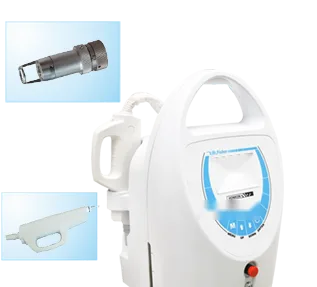
Pmise QN-05
Patented technology of single lamp and dual rods doubles energy output (400mj). Shorter pulse width (6-8ns) than ordina…
View details