
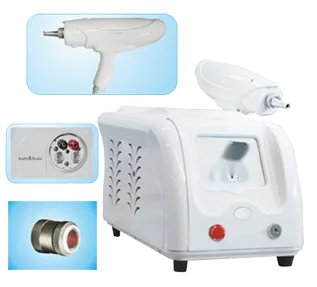
Straight answer: cafe au lait macules treatment means Q-switched laser work, usually a Q-switched Nd:YAG, and the outcome is hard to forecast. Some cafe au lait macules (CALMs) fade well over a course. Others barely shift. A few look clear at three months, then creep back.
What are you looking at, and when should you refer?
Flat brown patch. Even colour, regular edge, present since birth or early childhood. Our engineering archive is plain about them: they turn up anywhere on the body, neither raise nor pit the skin, cause no symptoms, never fade on their own, and darken with sun. Histology is simple too. Epidermal melanin rises and the melanocyte count rises with it. Superficial pigment, right where a nanosecond pulse reaches, which is why these lesions look easy on paper and disappoint in the chair.
Count the patches before you book anybody. DermNet sets out the National Institutes of Health criterion for neurofibromatosis type 1: six or more macules over 5 mm in children, or over 15 mm in adults. One patch is a cosmetic case. Six is a referral letter.
Why do cafe au lait macules respond so unpredictably?
You can clear pigment. You can't clear the tendency to make more of it. A nanosecond pulse shatters melanin that already exists, which is selective photothermolysis as Anderson and Parrish set it out in Science in 1983: deposit energy faster than heat escapes, and the absorber is destroyed while neighbouring tissue survives. Melanocytes underneath survive too. In some patients they quietly repopulate the patch.
Published work lines up with what clinics see. Zi-Zhen Guo and colleagues pooled the laser studies in a 2023 systematic review and meta-analysis in the European Journal of Medical Research. Their read: clearance varies widely between patients, recurrence after apparent clearance is real, and the Q-switched 1064 nm Nd:YAG came out ahead of the other devices reviewed. None of that hands you a number you can promise.
DermNet flags one useful predictor: lesions with an irregular margin have been reported to respond better than smooth, sharply defined ones. Treat the first macule as an experiment. Two or three sessions on it teach you more than any consulting-room prediction.
532 nm or 1064 nm for cafe au lait pigment?
Skin type decides, and it's a safety call before it's an efficacy one. Our device manuals are specific: 532 nm for Fitzpatrick types II to III at a spot of at least 3 mm, then 1064 nm from type III upward. The frequency-doubled green beam gets soaked up hard by superficial melanin. Lovely on fair skin. Risky on skin that pigments easily.
| Factor | 532 nm | 1064 nm |
|---|---|---|
| Melanin absorption | Strong, very superficial | Lower, penetrates deeper |
| Skin types (archived protocol) | Fitzpatrick II to III | Type III and above |
| Main risk to manage | Pigment change on darker skin | Under-dosing if you stay timid |
Read energy as fluence, not a bare mJ figure
Energy on its own tells you nothing. The spot here adjusts from 1 to 7 mm, so one number on the screen can describe two very different treatments. Tissue feels fluence: energy over area. The conversions below use energy values from our documentation. Reference points, not a prescription.
| Single pulse energy | Spot diameter | Approximate fluence |
|---|---|---|
| 200 mJ | 1 mm | about 25 J/cm2 |
| 200 mJ | 3 mm | about 2.8 J/cm2 |
| 200 mJ | 7 mm | about 0.5 J/cm2 |
| 400 mJ | 3 mm | about 5.7 J/cm2 |
| 800 mJ | 4 mm | about 6.4 J/cm2 |
Same 200 mJ in the first three rows, roughly fifty times the fluence at 1 mm as at 7 mm. Never write a number on a protocol sheet, or accept one from a supplier, unless the spot size travels with it.
Here's where people get caught out. Our archive is blunt that these lesions are energy-hungry: single pulse above 400 mJ at a pulse width under 7 ns, and a Q-switched pulse below 100 mJ close to useless. Read that 400 mJ marker as a 1064 nm reference point. Our Pmise QE-01 reaches 800 mJ at 1064 nm but caps near 400 mJ at 532 nm, because frequency doubling costs energy. Two wavelengths, two separate plans.
- 1064 nm, type III and above. Open near 200 mJ at 3 mm or wider and you've got real headroom. Climbing past the 400 mJ marker toward the 800 mJ ceiling stays available across sessions, spot diameter logged beside every energy value.
- 532 nm, types II to III. Open near 200 mJ at 3 mm or wider, about 2.8 J/cm2. Your ceiling is roughly 400 mJ, about 5.7 J/cm2 at that spot. Double the fluence, no further.
- When the 532 nm route stalls. More millijoules isn't the answer. Re-plan: more sessions at the same setting, or an honest look at whether this lesion responds at all. Green light hits epidermal melanin much harder, so your margin before pigment change is narrower.
A staged cafe au lait macules treatment protocol
Conservative first, review, then escalate. Our device manuals frame this as staged work, not one hero session. Screen first; the archived contraindication list rules out more cases than most clinics expect.
- Cardiac pacemakers or implanted defibrillators
- Pregnancy
- Severe diabetes, hypertension, heart disease or epilepsy
- Broken skin, active herpes, malignant lesions or scars at the site
- Functional cosmetics used in the past month
- Recent tanning, isotretinoin or other photosensitisers
- Assess and document. Count and measure the macules, ask about family history, photograph under fixed lighting, refer if the pattern suggests a syndrome.
- Pick the wavelength from the Fitzpatrick skin type, and write down why.
- Eye protection before the first pulse: wavelength-rated goggles, patient and everyone in the room.
- Handle pain sensibly. One small macule is usually fine with cooling and short passes; our archive suggests topical anaesthesia, typically an occluded lidocaine gel, for large or sensitive areas.
- Test spot at the lesion edge, then wait four weeks. Pigment needs that long to declare itself. Record energy and spot together. A sheet reading "200 mJ" with no diameter is worthless to the next operator.
- Watch the endpoint, not the clock: our manuals put it at the treated area turning light red with pigment visibly scattered. Never chase it by winding energy up mid-session; the manuals warn that excess energy causes blood oozing and triggers pigmentation.
- Escalate between sessions only, at the documented 45 to 60 day review. Don't park at a timid setting either. An under-dosed pass burns a cycle.
- Aftercare: gel to keep the site moist, a light scab left to fall off, strict sun avoidance, repairing essence for about seven days. Six to eight sessions at that spacing.
Children are a separate conversation, and that call belongs to the treating clinician and local regulation, never an equipment supplier. Crowding sessions is the commonest field mistake: the clinic wants visible progress, rebooks at three weeks, and stacks post-inflammatory hyperpigmentation on the original lesion.
Recurrence: what to say before the first pulse
Put recurrence in the consent conversation, in writing, before money changes hands. Our archive lists relapse and pigment change among the recognised complications, and pooled data agrees lesions can return after looking clear. Patients accept uncertainty when you name it early. They don't accept a promise that falls apart at month nine.
- Frame session one as a trial of how that skin behaves, not a guaranteed course.
- Say out loud that some lesions clear well, some improve partially, some come back.
- Quote the real course length, and be direct about pigment-change risk on darker skin.
- Book a written review point, so a partial result is a planned discussion.
Clinics that do well here sold a trial and delivered a course. The ones that struggle did it the other way round.
Which Pmise system suits this work?
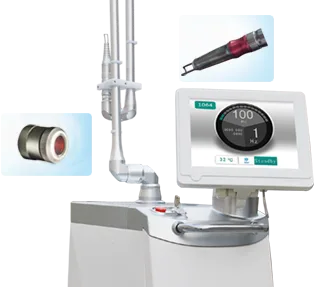
Two wavelengths, genuine nanosecond pulses, energy in reserve at 1064 nm, fine spot control. Our Q-switched Nd:YAG laser range covers this class of lesion, and for serious pigment work we point buyers at the Pmise QE-01 in the EO Q-switched line: dual 1064 nm and 532 nm, up to 800 mJ at 1064 nm and 400 mJ at 532 nm, pulse width 6 ns or under, spot adjustable 1 to 7 mm, articulated arm. Where space is tight, the portable Pmise QN-09 is the same idea, smaller.
| Buyer checkpoint | What to ask for in writing |
|---|---|
| Energy at both wavelengths | Single-pulse ceiling at 1064 nm and at 532 nm, quoted separately, plus the spot range. One headline figure hides the frequency-doubled limit that shapes your fair-skin protocol. |
| Certification and warranty | CE Declaration of Conformity for the exact model, EMC and low-voltage test reports, and the factory's FDA, CE, RoHS and SGS certificates. One year free service on material or process defects, with a valid invoice and warranty card. |
| Training | English operator manual, remote applications training, and a parameter sheet listing spot size beside every energy. |
Lamp life and servicing sit in our running costs guide; full workflow and cautions on the CALMs solution page. Same reasoning in our nevus of Ota and melasma write-ups. Send your skin-type mix via the contact page for a quotation.
Frequently Asked Questions
Can a Q-switched laser remove a cafe au lait macule permanently?
Sometimes, but don't promise it. A Q-switched Nd:YAG clears visible pigment in many of these lesions over a course, and pooled published data favours the 1064 nm Nd:YAG. Clearance still varies widely, and recurrence after apparent clearance is recognised. Treat the first lesion as a test, then review honestly before selling a course.
How many sessions do cafe au lait macules need?
Plan for six to eight, spaced 45 to 60 days apart as our device manuals specify, with pigment fading over roughly four weeks after each pass. That's most of a year, and patients should hear it at consultation. Squeezing sessions closer doesn't speed clearance, and it raises the risk of pigment complications.
What energy should I start at?
Better question: what fluence, at what spot? Our archived protocol opens near 200 mJ at 3 mm or wider, roughly 2.8 J/cm2. Where you go next depends on wavelength. At 1064 nm there's headroom above the 400 mJ marker; at 532 nm the platform caps near 400 mJ, so plan inside that range.
Is 532 nm safe on darker skin?
Our archived protocol keeps 532 nm to types II to III, then moves to 1064 nm from type III upward. Green light is absorbed strongly by epidermal melanin, so on skin that pigments readily the epidermis competes with your target. DermNet lists transient or permanent hyperpigmentation, hypopigmentation and scarring among reported laser risks. Test spot first, always.
Pmise Technical Team, laser applications and product engineering. Published 10 April 2026, reviewed June 2026. Pmise manufactures Q-switched Nd:YAG and light-based systems and supports clinics with operator training and written protocols. Written for trained practitioners, not medical advice.