
Pigment Treatment
Mongolian Spot Treatment: When to Wait and When to Use a Q-Switched 1064 nm Nd:YAG
A Mongolian spot is a flat blue-grey birthmark a baby is born with, usually across the lower back. Most fade on their own. So mongolian spot treatment with a Q-switched 1064 nm Nd:YAG laser is held back for the stubborn minority, where pigment sits deep in the dermis and nothing shallower reaches it.
Written for clinics and distributors comparing light-based equipment. Educational, not medical advice.
What a Mongolian spot actually is
The clinical name, congenital dermal melanocytosis, describes the cause better than the old one. Melanocytes begin life near the neural crest and migrate toward the epidermis. Some never arrive. They park in the dermis, keep making melanin, and that stranded pigment shows through as a bluish patch. Why blue, not brown? Scattering. Deep pigment reads as slate, the Tyndall effect.
What your operators should recognise on sight:
- Present at birth or within the first weeks. Never acquired in adulthood.
- Grey-blue or greenish, flat, soft borders. It doesn't itch or hurt.
- Usually lumbosacral. Sometimes shoulders, limbs or face.
- Far more common in infants of Asian, African and Hispanic heritage.
- No sun reactivity, which separates it from freckles.
One warning belongs here. These patches look like bruises, so paediatric teams document them at birth to stop a birthmark being read as injury, a point the StatPearls chapter on dermal melanocytosis makes explicitly. A 2024 review in the Journal of Cosmetic Dermatology adds that newborns with extensive, non-fading spots may have an underlying metabolic disorder, mucopolysaccharidosis and GM1 gangliosidosis among them. Paediatric referral, not a laser case.
Why most fade, and which ones don't
Time does the heavy lifting. Cleveland Clinic states that many disappear during a child's first year, the majority are gone by age six to ten, and treatment normally isn't needed. A small share carries on into adult life. Which is why a careful clinic reaches for a camera before a handpiece.
Some lesions really do stay. The 2024 review by Zhu and colleagues describes spots that are darker, more numerous, sited outside the sacral region, or wider than 10 cm as likelier to persist. Off-sacral patches get labelled ectopic, and those are the ones that walk into a clinic.
Timing is the whole argument. Treat a sacral spot on an infant and you may be treating something that was going to vanish anyway. Leave a facial ectopic patch too long and a child carries a visible mark through the years when it stings most. Zhu's group suggests starting before age five when a lesion clearly isn't resolving.
How a Q-switched laser clears dermal pigment
Your target is melanin locked inside melanocytes below the epidermis. Reaching it takes light that melanin absorbs, in a pulse short enough to shatter the granule before heat leaks outward. That's selective photothermolysis, set out by Anderson and Parrish in Science in 1983, and every pigment laser built since runs on it.
A Q-switched Nd:YAG fires 1064 nm in pulses lasting a few nanoseconds. Long wavelength, deep reach. Energy lands faster than heat escapes, so the granule fractures mechanically instead of cooking its neighbours. Broken pigment then leaves two ways: a little works up as crust, the rest gets carried off by phagocytes.
Most platforms here also offer 532 nm, which suits superficial brown and red lesions and won't touch dermal melanocytosis. The working wavelength is 1064 nm, full stop. Clearance builds slowly and shifts with depth, colour, age and skin type, so no honest operator quotes a session count.
Treatment protocol and what to expect
For a classic sacral spot the default answer stays no treatment. Watch it, reassure the parents, file a dated photo. Laser work belongs to persistent, ectopic or distressing lesions. The table is equipment planning, not a prescription.
| Parameter | General guidance |
|---|---|
| Wavelength | 1064 nm Q-switched Nd:YAG |
| Pulse width | Around 6 to 8 ns on our platforms |
| Spot size | Adjustable. Larger spots for deeper penetration |
| Sessions | Several. Manuals plan around six to eight for dermal melanocytic nevi |
| Spacing | Roughly 60 to 90 days in manual guidance |
| Endpoint | Light frosting or faint erythema |
| Outcome | Gradual lightening; varies by lesion and skin type |
In session, the operator selects 1064 nm, picks a spot size to suit the lesion, and tests low first. Our engineering archive is blunt about the geometry: at the same fluence a wider spot goes deeper, so deep pigment is no job for a pinpoint beam. The manuals warn against under-dosing too, since pigment that never fractures never clears. Wavelength-rated eyewear isn't negotiable.
Recommended Pmise equipment
The specifications that decide this purchase are unglamorous: stable 1064 nm output, enough single-pulse energy to fracture deep pigment, a genuinely short pulse width, and a spot adjuster you can trust shot after shot. Our QN series is built around that brief, with adjustable spot diameter, stepped energy control and 1 to 10 Hz repetition. Compare the QN-03 and QN-11 on the Q-switched Nd:YAG laser page. Busy clinics often step up to an electro-optic Q-switch, where continuously adjustable energy beats fixed steps on difficult skin; weigh that on the EO Q-switched Nd:YAG laser page.
One platform covers a family of related indications, which is the real commercial case for buying it. Our walkthrough of nevus of Ota treatment with laser digs into settings logic, and the nevus of Ota solution page handles diagnosis. Physics carries across. Expectations don't, since Ota never fades by itself.
What clinics ask before buying
Specifications settle the clinical question. These five settle the commercial one.
- Certification and market access. Ask what documentation travels with the machine. Our archive holds CE EMC and low-voltage safety reports covering the Nd:YAG range. Registration is national, though, and the file Brazil wants isn't the file Poland wants.
- Warranty and wear parts. Two questions beat the headline warranty length. What's covered, and what counts as a consumable? On a lamp-pumped platform the flash lamp and optical crystal are the finite-life parts, priced separately. Get both in writing.
- Training and clinical support. A pigment laser earns nothing sitting in a corner. Ask about operator training at handover, the parameter tables in the manual, and who your team phones when a case misbehaves.
- Lead time and spares. Confirm build time before payment, and what's in the crate. Our manuals tell the receiving clinic to check the spare-parts kit against the packing list. Order a spare protective fuse tube too. Cheap, and it strands a healthy machine.
- After-sales servicing. Upkeep on a water-cooled laser is mundane and not optional: our manuals call for a full water change roughly every two months and forbid opening the housing. Ask how remote diagnosis works and whether spares ship from stock.
Tell us your caseload, skin types and planned indications. Request specifications and a quote for your caseload and our application engineer will map the options against what you treat.
Aftercare, risks and red flags
Good aftercare protects the result. Send it home written down:
- Keep the area clean and dry, with whatever topical care you've prescribed.
- Leave crusts alone. Picking is where scars begin.
- Broad-spectrum sun protection between every session.
- Phone the clinic about blistering, spreading redness or signs of infection.
- Don't compress the schedule. Pigment clearance takes weeks; rushing gains nothing.
Now the risks. Post-inflammatory hyperpigmentation is the common one after any pigment laser, and darker Fitzpatrick types carry more of it; Zhu's review flags it as the leading complication in East Asian patients and recommends dialling energy down rather than up. Hypopigmentation and, rarely, scarring follow aggressive settings. Conservative fluence, long intervals and sun avoidance move that risk. Defer in pregnancy. Never treat broken skin, active infection, or a lesion you suspect could be malignant.
If the diagnosis is uncertain, the lesion has changed, or a patch is unusually large, refer before you treat. Biopsy or paediatric assessment beats a confident guess.
Frequently Asked Questions
Do Mongolian spots need to be removed?
Usually not. Classic patches over the lower back are benign, and Cleveland Clinic notes most are gone by age six to ten on their own. Observation is standard. Treatment enters the conversation when a spot persists, sits somewhere visible, or distresses the family.
Which laser is used for a persistent Mongolian spot?
A Q-switched Nd:YAG at 1064 nm is the usual first choice. That wavelength reaches dermal pigment, and its nanosecond pulse fractures melanin granules rather than heating the tissue around them. Alexandrite, ruby and picosecond systems are reported too. Which fits depends on lesion, skin type and operator.
How many sessions does it take?
No fixed number, and be wary of anyone quoting one. Deep pigment clears slowly, so persistent lesions need several sessions weeks to months apart. Our device manuals plan around six to eight sessions at roughly 60 to 90 day intervals for dermal melanocytic nevi. Operating guidance, not a promise.
Is laser treatment safe for children?
It's performed in children, and Zhu's review argues ectopic lesions do better treated before age five. Balance that against one plain fact: most spots fade untreated. That call weighs a low chance of a lasting lesion against a small procedural risk, and it belongs to a paediatric dermatologist.
Still comparing models? Talk to our application engineer about dermal-pigment protocols and we'll send specifications, certification documents and pricing for the right configuration.
References
- Anderson RR, Parrish JA. Selective photothermolysis: precise microsurgery by selective absorption of pulsed radiation. Science. 1983;220(4596):524-527. DOI
- Cleveland Clinic. Congenital Dermal Melanocytosis. my.clevelandclinic.org
- Zhu J, Cen Q, Chang R, Han Y, Lin X. Patchy Dermal Melanocytosis: Differential Diagnosis and Management. Journal of Cosmetic Dermatology. 2024;24(1):e16607. PMC11743229
- Chua RF, Pico J. Dermal Melanocytosis. StatPearls Publishing. NCBI Bookshelf NBK557408
Recommended Equipment
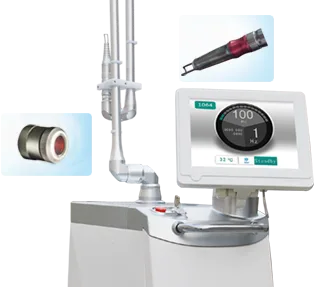
Pmise QE-01
Dual wavelengths (1064nm & 532nm) are convenient to adjust by touching LCD. Multi-spot size (1-7mm) is ideal for a wide…
View details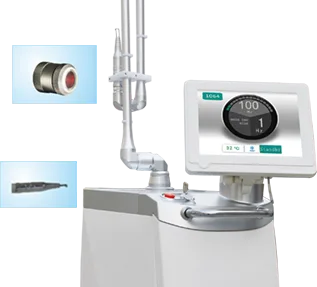
Pmise QE-02
Dual wavelengths (1064nm & 532nm) are convenient to adjust by touching LCD. Multi-spot size (1-7mm) is ideal for a wide…
View details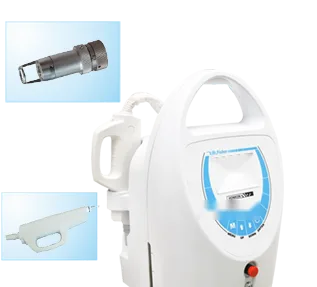
Pmise QN-05
Patented technology of single lamp and dual rods doubles energy output (400mj). Shorter pulse width (6-8ns) than ordina…
View details