
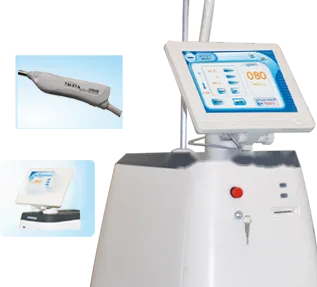
Nail fungus laser treatment works by heat, not by magic. A long-pulse 1064nm Nd:YAG pushes light through the nail plate, that light becomes heat in the nail bed, and the heat disrupts the fungus behind onychomycosis. No pills. No cutting. It's also not a cure, and a clinic selling it as one is building a refund queue. Here's the physics, the dose question, who you shouldn't treat, and what to check before buying one.
How does a laser kill nail fungus?
It cooks the fungus. It doesn't vaporise it. Light at 1064nm passes through the hard nail plate, gets absorbed underneath, and becomes heat in the nail bed where the organism lives. Raise the temperature far enough, hold it long enough, and fungal growth is disrupted.
How far, how long? That's where the field stops agreeing. The 2019 device review by Kawa and colleagues in the Journal of Clinical and Aesthetic Dermatology states it word for word: "The utility of laser treatments is thought to rely on heat transfer to fungal mycelium, reaching fungicidal temperatures of 43°C to 51°C for 2 to 3 minutes; lower temperatures can lead to stimulation of fungal growth." Pin that last clause above the treatment couch. Under-heating isn't neutral. It may backfire.
Read the two-to-three-minute figure as one reported estimate, not a settled dose. Lab work points at longer holds. Paasch and colleagues, in the International Journal of Hyperthermia in 2013, reported that "complete pathogen growth impairment was achieved if temperatures were measured above 50 °C". Different organisms, different rigs, different answers. No validated thermal dose exists here, so be wary of a supplier claiming one.
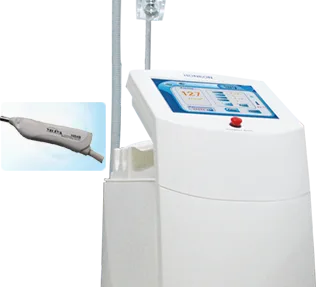
Why 1064nm, and why long pulse?
Depth. That's the whole answer on wavelength. The infection sits under a thick keratin lid, and penetration rises with wavelength. Our internal training material on light-tissue interaction defines penetration depth as the distance over which light falls to 37 percent of starting intensity, and 1064nm sits at the deep end of the aesthetic range.
Pulse duration is the other half. Anderson and Parrish set out the logic in their 1983 paper on selective photothermolysis in Science: pick the wavelength your target absorbs, then pick a pulse duration that lets heat build there rather than leak into everything around it. Nails need bulk warming across a few millimetres, so you want milliseconds, not nanoseconds. Our technical documentation puts it plainly: a wider pulse width gives a gentler photothermal effect in deeper tissue. Nanosecond Q-switched pulses do the opposite, shattering pigment mechanically. Superb for tattoo ink, useless on a nail bed. Our breakdown of long-pulse versus Q-switched Nd:YAG and the piece on thermal relaxation time cover the trade-off.
What does a treatment session actually look like?
Short, repeated, unglamorous. No universal protocol has been published, and the reviews say so, but clinic workflows converge:
- Trim, thin and debride the nail. Light stopped by debris never reaches the bed.
- Eyewear on everyone, operator included. These are Class 4 systems and diffuse reflection off a nail is a genuine hazard.
- Move the handpiece in a slow spiral or raster over the whole plate and the surrounding fold, not just the discoloured part.
- Watch the patient. Warmth is the endpoint you titrate to, and their feedback is your gauge. Screen first: that gauge fails in some patients (next section).
- Pause, let the nail cool, repeat per your protocol, and book the follow-up before they leave. This is a course, not a visit.
Our engineering archive for the dedicated nail platform describes a delivery pattern rather than a dose: a spiral irradiation path across the nail, taking it to around 50°C in a short time, then stopping the laser for about a minute so the temperature falls back toward 40°C before the next pass. Heat, hold, rest, repeat. Each treatment runs roughly five to ten minutes, and the patient reports tepid warmth rather than pain.
Be straight about what that is and isn't. Repeated heat-and-rest cycles are meant to build exposure at the nail bed across a session, since one uninterrupted hold at fungicidal temperature would punish the nail fold long before it troubled the fungus. Neither our archive nor the literature shows that this cycle delivers the exposure window quoted above. The two aren't equivalent and we won't pretend otherwise. Run the settings your supplier validates.
Toenails grow slowly, which ruins most patient expectations. Clear nail creeps out from the base over months. The tip they keep staring at was already dead keratin.
Who should not be treated, and who needs extra care
Screening comes before selling. Step 4 above makes patient-reported warmth your safety endpoint, and that endpoint fails silently in anyone whose feet don't register heat properly. Onychomycosis is over-represented in exactly that group: the American Academy of Family Physicians' 2021 rapid evidence review lists diabetes mellitus, peripheral vascular disease and immunocompromised states among the comorbidities that raise risk.
- Impaired thermal sensation. Diabetic peripheral neuropathy, other neuropathies, any numbness in the feet. If a patient can't reliably tell you it's getting too hot, you have no endpoint.
- Vascular compromise. Peripheral vascular disease, poor circulation, cold or dusky toes. Reduced perfusion means slower heat clearance and healing.
- Impaired healing or immunosuppression. A small thermal injury on a foot that heals badly isn't small.
- Active infection, ulceration or broken skin near the nail. Treat that first.
- Anything outside your competence. Pregnancy, photosensitising medication, uncertain diagnosis. Refer, don't guess.
Confirm the diagnosis too: thickened discoloured nails can equally be trauma, psoriasis or lichen planus. Patients in the groups above should be assessed or cleared by a physician before you book a course. Suitability is a clinical judgement, not a commercial one.
Does laser treatment for onychomycosis really work?
Some nails improve. Many improve partially. Regulatory language tells you how confident the field is: Nd:YAG systems have been cleared in the United States for a temporary increase of clear nail in onychomycosis, a cosmetic indication, not a claim of cure. Read that twice before writing website copy.
The literature leans the same way. Kawa and colleagues concluded that variation in laser parameters, treatment frequency and causative pathogen makes outcomes hard to compare, that standardised regimens are still needed, and that cure rates stay low against current standards of care. The British Association of Dermatologists' 2014 guideline called Nd:YAG and other newer devices promising while declining to recommend them.
So position the device inside a plan: the AAFP review notes that combining laser with topical therapy increases effectiveness. And treat relapse as a management problem, not a device failure. The shoes and the untreated athlete's foot outlive the course.
Laser or oral antifungals: which do you recommend?
Neither wins outright, and the interesting cases use both. Drug selection is a physician's call, so keep your side on the device.
| Factor | Long-pulse 1064nm laser | Oral antifungal therapy |
|---|---|---|
| Mechanism | Local heating of the nail bed | Systemic drug reaching the nail |
| Side effects | Local heat and discomfort | Systemic; some patients need monitoring |
| Course length | Several short sessions over weeks | Six weeks for fingernails, twelve for toenails on terbinafine, per AAFP |
| Evidence base | Limited; cleared for temporary increase in clear nail | Established first-line therapy |
What should you check in the machine and the paperwork?
This treatment lives or dies on controlled heat, so hardware matters more than the sticker price. A platform that can't hold output through a busy afternoon will quietly under-treat people. Buying across a border adds a second checklist, nothing to do with optics.
- Real long-pulse range and contact cooling. Our device manuals specify pulse widths up to 50ms on the long-pulse Nd:YAG platform behind the Pmise LN-01, whose handle carries sapphire cooling. The nail fold limits patient tolerance, so protecting it lets you deliver useful energy.
- Adjustable spot, cooling that lasts a day. The LN-01 offers a 1 to 10mm spot, the sapphire-cooled handle covering 1 to 6mm, and our documentation rates its compressor cooling for 24 hours continuous.
- Class 4 safety in the workflow. Footswitch, interlock, signage, eyewear. Our laser safety essentials guide has the list.
- Regulatory documents, named and dated. Ask for the CE certificate and declaration of conformity, the factory's ISO 13485 evidence, and the exact wording of the cleared or registered indication. If a supplier claims US clearance, ask for the 510(k) number and read what it covers. Request the current certificate set for the model quoted, Pmise LN-01 or LN-03 included, rather than assuming a certificate travels between variants or markets. Our comparison of FDA 510(k) and CE shows why the routes differ.
- Commercial terms in the contract, not the chat window. Warranty period and cover, lead time from deposit, voltage and plug configuration, spare-parts stock, replacement shipping time, and who pays that freight. Our notes on warranty and spare parts list what buyers forget.
- Claim compliance at home. Your advertising ceiling is your registered indication, not the manufacturer's brochure. If your registration covers a temporary increase in clear nail, that's the strongest claim your site may make. Get training commitments in writing too.
Pmise builds long-pulse 1064nm platforms in this class, including the Pmise LN-01 and Pmise LN-03. Want a straight answer on whether your case mix justifies the purchase, or the document pack for your registration route? Pmise service and support can help.
Frequently Asked Questions
Is nail fungus laser treatment painful?
Most people describe warmth building to a hot pinprick, then relief when the operator pauses. Not sharp pain. A cooled handpiece and proper pauses keep it comfortable, and our archive for the nail platform calls the sensation tepid. Discomfort tracks the heat delivered, so operators titrate to feedback.
How many sessions does toenail fungus need?
Plan a course of several sessions over weeks, not a single visit. Published protocols vary widely, which clinical reviews flag as a weakness in the evidence, so follow your manufacturer's guidance and your own judgement. Then wait: a toenail grows slowly and the payoff appears gradually from the base.
Does the laser permanently cure nail fungus?
No, and don't say it does. US clearances describe a temporary increase in clear nail, and the 2019 Journal of Clinical and Aesthetic Dermatology review concluded that cure rates with device-based options stay low against current standards of care. Onychomycosis is chronic, and relapse is common unless footwear and skin infections are tackled.
Can any 1064nm laser be used on nails?
Not really. The job needs genuine millisecond pulse capability, contact cooling and a spot size suited to small targets. A Q-switched-only system is built for pigment destruction and won't give the sustained warming a nail bed needs. Confirm intended use, pulse widths and settings before advertising the service.
Written by the Pmise Technical Team. Pmise manufactures laser and light-based aesthetic equipment, including long-pulse Nd:YAG platforms, and works from its own engineering files and published clinical literature.