
General Solutions
The Complete Solution of Hair Removal Problems
Unwanted terminal hair on the lip, underarm, bikini line or legs is treated in clinic with laser hair removal: a chosen wavelength is absorbed by melanin inside the hair shaft and follicle, that energy becomes heat, and the structures that grow the next hair are damaged.
This page is for people who buy and run the machines. Educational content, not medical advice.
What you are actually treating
A hair sits in a follicle that tunnels down to the papilla, a base fed by capillaries and nerve endings. Pigment cells live down there too. Terminal hair on legs, underarms and bikini line is coarse, dark and rooted deep.
Sometimes the hair is a symptom, not a complaint. Sudden or severe growth in a woman can point to a hormonal driver such as polycystic ovary syndrome. No laser fixes that. Screen the history, refer where warranted.
How laser hair removal works
The governing idea is selective photothermolysis, published by Anderson and Parrish in Science in 1983: pick a wavelength and pulse duration that heat your target far more than the tissue around it. Here the chromophore is melanin, sitting in the hair shaft and follicular structures. Light crosses the epidermis, pigment absorbs it, heat damages the papilla and the stem cell zone above it.
Two consequences follow. Pale hair barely responds, because melanin is the target. And the epidermis carries melanin too, so the surface competes with the follicle for the same photons. Our archive names the endpoint plainly: small papules around the follicle openings, skin pink and warm.
The hair cycle sets the schedule
Every follicle runs a repeating hair cycle with three phases. Anagen is active growth, and the follicle holds the most pigment then. Catagen is the shutdown: growth stops, capillaries retreat, the papilla shrinks. Telogen is rest, when the old hair sheds. Anagen runs far longer than the other two, and its length varies by body region. An eyebrow and a lower leg never share a clock.
Only anagen hairs respond well, because only they carry the pigment your laser needs. At any moment just a share of the hairs in an area are growing, so one pass cannot clear it. Courses are not a sales tactic. They are arithmetic.
The American Academy of Dermatology puts most patients at two to six treatments, once every four to six weeks, and reports most stay hair free for months or even years afterwards. Our diode manuals set a floor of 28 days between sessions on one area, and regrowth, when it comes, is usually sparser.
Be careful with the word permanent. In its device clearances the US FDA defines permanent hair reduction as a long-term, stable reduction in the number of hairs regrowing, measured at 6, 9 and 12 months after a regimen ends. Reduction, not eradication. Say so at the consultation and you will argue about refunds far less often.
Courses disappoint in predictable ways. Sessions get booked around the patient's diary instead of the hair cycle. Energy stays timid because the cooling cannot support more. The patient waxes between visits and removes the target the beam needs. Or the hair is grey and never had pigment. Each failure mode is unpacked in why laser hair removal fails.
Wavelength, energy and cooling by skin type
The 808nm diode is the workhorse for hair. It reaches the bulb at depth while still being absorbed well by melanin, a compromise no other single wavelength strikes as neatly. Our diode manuals cover Fitzpatrick I through VI on that wavelength, provided the operator drops energy and repetition rate as skin gets darker.
Deeper follicles want a longer wavelength and a bigger spot. Denser follicles want less energy.
Very dark skin is where a second wavelength earns its keep. At Fitzpatrick V and VI, epidermal melanin absorbs much of an 808nm pulse before it reaches the follicle, and that stolen heat is what burns skin and shifts pigment. Long-pulse 1064nm Nd:YAG is absorbed less by surface pigment, which is why our manuals list it for types IV to VI. Mixed patient base? Keep both. See Fitzpatrick skin types and laser settings.
Cooling is the third variable, and buyers underrate it constantly. A sapphire contact tip pulls heat out of the epidermis at the instant of the pulse, which is what lets you run a fluence that destroys follicles rather than annoying them. Weak cooling forces timid energy. Timid energy lets hair grow back.
Pmise equipment and starting parameters
For most clinics the Pmise 808nm diode laser platform is the sensible first purchase. Pulse width, energy density and repetition rate all adjust, so an operator can start low and titrate against the skin. Below are documented specs plus two starting points. A frame, never a recipe.
| Parameter | Documented value, Pmise 808nm diode |
|---|---|
| Wavelength | 808nm diode |
| Skin types | Fitzpatrick I to VI |
| Spot size | 12mm x 12mm |
| Pulse width | 5 to 200 ms, adjustable |
| Repetition rate, machine range | 1 to 10 Hz |
| Max energy density | Up to 120 J/cm2 |
| Epidermal cooling | Sapphire contact tip |
| Leg start point, type I to II | From 10 J, 20 to 45 ms, 5 to 10 Hz |
| Leg start point, type V | From 5 J, 20 to 40 ms; reduce repetition rate below the type I to II range |
| Minimum interval, same area | 28 days |
Read the type V row for what it is: a documented starting energy and pulse width, nothing more. No repetition rate is printed there, on purpose. Frequency on darker skin gets stepped down, never matched to fair skin. Our manuals put it in one line. Darker skin, lower frequency and lower energy; paler skin, the reverse. They also spell out the cost of ignoring it. Too much energy, too long a pulse, or a high frequency on dark skin, and the tissue absorbs more heat than it can shed. That is a burn.
A second brake is worth knowing. Our operation manual ties pulse width to a frequency ceiling: 5 to 20 ms runs up to 10 Hz, 25 to 40 ms drops to 1 to 5 Hz, 45 to 100 ms to 1 to 2 Hz, past 100 ms it sits at 1 Hz. Where a parameter table and that ceiling disagree, take the lower number. Then move in small steps, no more than 5% of energy or 5 ms of pulse width. Comparing platforms? Diode vs alexandrite vs Nd:YAG.
Aftercare and precautions
- Shave and clean the area first. Surface hair burns and hurts. The follicle is the target.
- Test first. Our manuals call for a couple of low-energy shots on a small area, then a pause to read the skin.
- Sunblock for at least ten days after a session, no tanning for ten days before one. Tanned skin is loaded with the chromophore you want to avoid.
- No saunas or heat stimulus for three days, no chemical or mechanical irritation for a week, and at least 28 days before the next session on that area.
- Warn darker-skinned patients about post-inflammatory hyperpigmentation and pigment loss. Both sit in the documented complication list, alongside burns and folliculitis.
- Everyone in the room wears eyewear. Retinal injury has no aftercare.
- Screen out active infection, tattoos in the field, keloids, photosensitising drugs, pregnancy and recent hormone therapy.
Before you order: compliance, training and support
Clinical fit is half the decision. Here is the other half.
- Regulatory status. Our diode and Nd:YAG platforms are built under a quality system certified to EN ISO 13485, covering design, production, sales and service. LVD safety and EMC certificates sit on file. Ask for current copies with your quotation.
- Operator training. Every machine ships with a manual covering installation, treatment process, precautions, adverse reactions, aftercare and fault-finding, plus parameter tables by skin type and body area.
- Serviceability. Handpiece, control board, LCD board, screen and water filter are stocked spares, so a fault is a part swap, not a dead room. Warranty and lead time go in writing on the quotation. See warranty and spare parts.
Frequently asked questions
Is laser hair removal permanent?
Long-term reduction is the honest description. FDA device language defines permanent hair reduction as a stable drop in regrowing hairs, measured at 6, 9 and 12 months after a course ends. Not the same as clearing every hair forever. Expect thinner regrowth and some maintenance.
How many sessions should I quote a patient?
The AAD figure of two to six treatments, once every four to six weeks, is a fair frame for a consultation. Real numbers shift with hair colour, coarseness, skin type and body area. Coarse dark body hair gives ground faster than fine facial hair. Quote a range, not a promise.
Can one machine cover Fitzpatrick I to VI?
An 808nm diode is documented for I to VI, but the settings are not interchangeable. Energy and repetition rate both come down as skin darkens, and a room treating many type V and VI patients is safer with a long-pulse 1064nm option alongside it. Judge the patient mix first.
What about grey, white or fine blonde hair?
Poor candidates, and no machine changes that. These hairs hold little or no melanin, so there is nothing for the beam to heat selectively. Say so during the consultation, not after session three. Where growth is endocrine-driven, the cause needs managing too.
This guide is educational content for equipment buyers. It does not replace clinical training, local device rules, or assessment of an individual patient.
Next step. Tell us the skin types and body areas your room handles, and we will send the 808nm diode spec sheet. Ask for a quotation.
Recommended Equipment
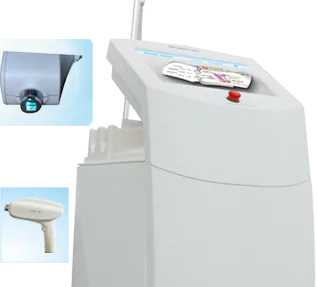
Pmise DL-04
Pmise DL-04 adopts the laser source with German micro-channel cooling technology. Max output power 600W (with 500W and …
View details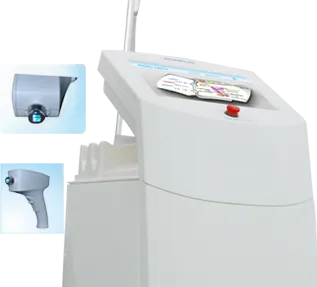
Pmise DL-05
No topical anesthetic is required, eliminating lengthy treatment preparation No treatment gel is used during high speed …
View details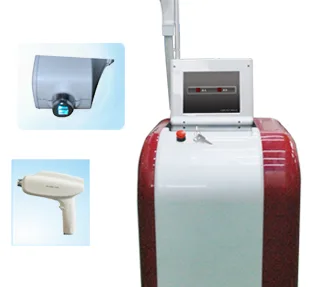
Pmise DL-07
No topical anesthetic is required, eliminating lengthy treatment preparation No treatment gel is used during high speed
View details